
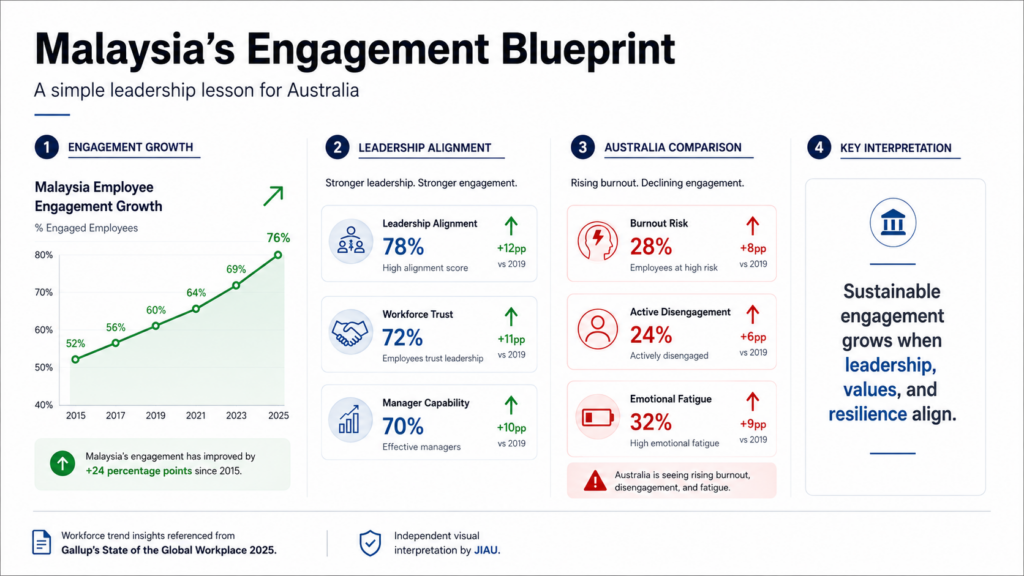
According to Gallup workplace engagement reporting and APAC workforce analysis, Malaysia has steadily improved workforce engagement over the past decade through stronger leadership alignment, manager capability, and values-driven workplace culture.
While many organisations across APAC continue struggling with burnout, disengagement, and workforce instability, Malaysia has quietly built something more sustainable:
Steady engagement growth.
Not explosive.
Not temporary.
Sustainable.
Australia, meanwhile, continues facing:
- stagnant engagement
- rising burnout
- increasing active disengagement
- declining morale
- emotional fatigue across leadership and frontline teams
So what explains the difference?
Malaysia demonstrates a critical truth modern organisations must understand:
Engagement grows when values, judgement, and role alignment work together.
And in a future shaped by constant pressure and uncertainty, this lesson matters more than ever.
Sustainable Engagement Is Built Slowly
Many organisations search for rapid engagement fixes.
They launch:
- culture initiatives
- wellness programs
- engagement campaigns
- employee benefits
- motivational strategies
But sustainable engagement rarely grows through isolated initiatives alone.
It grows through consistency.
Malaysia’s workforce improvements increasingly reflect stronger organisational foundations around:
- leadership alignment
- clearer expectations
- manager capability
- relational trust
- emotional stability
- values-based leadership
These factors create environments where employees feel psychologically safer and more connected to their work.
Australia’s Engagement Problem Is Becoming Chronic
Australian workplaces are increasingly operating under conditions of:
- emotional overload
- chronic urgency
- leadership fatigue
- constant change
- unclear priorities
- rising psychological exhaustion
Over time, these conditions weaken:
- resilience
- trust
- engagement
- adaptability
- emotional sustainability
Employees may still perform operationally.
But internally, many feel:
- disconnected
- emotionally depleted
- unsupported
- uncertain about organisational direction
This creates workforce fragility.
And fragile workforces eventually become unstable under pressure.
Malaysia Demonstrates the Power of Leadership Alignment
One of Malaysia’s strongest engagement advantages has been improving manager capability and leadership consistency.
Employees perform better when leaders provide:
- clarity
- stability
- emotional regulation
- communication consistency
- accountability
- relational trust
Strong leadership stabilises workforce judgement under stress.
Weak leadership amplifies pressure.
This distinction is becoming increasingly important across APAC as work environments grow more psychologically demanding.
Why Values Alignment Matters More Than Ever
Modern employees increasingly want workplaces that align with:
- personal values
- identity
- contribution
- meaning
- long-term wellbeing
When values alignment weakens:
- engagement declines
- motivation becomes unstable
- resilience weakens
- emotional fatigue accelerates
- burnout risk increases
Malaysia’s workforce improvements increasingly reflect stronger alignment between:
- organisational expectations
- leadership behaviour
- employee contribution
- workplace meaning
This creates stronger emotional sustainability under pressure.
Judgement Quality Determines Workforce Stability
Most organisations still focus heavily on operational performance metrics.
But sustainable engagement depends heavily on judgement quality.
Judgement affects how employees:
- handle pressure
- communicate under stress
- solve problems
- regulate emotions
- maintain resilience
- adapt to uncertainty
When judgement deteriorates:
- trust weakens
- engagement declines
- burnout spreads
- leadership becomes reactive
- culture destabilises
This is why workforce performance can no longer be separated from psychological resilience.
Why Traditional Engagement Surveys Miss the Bigger Problem
Most engagement tools measure emotional outcomes after workforce instability already exists.
They identify:
- dissatisfaction
- frustration
- low morale
- disengagement
But they rarely measure:
- resilience quality
- judgement stability
- burnout vulnerability
- emotional sustainability
- coping capacity
- values alignment
This creates delayed organisational awareness.
By the time engagement visibly declines, pressure-related damage may already be widespread throughout leadership teams and organisational culture.
How the Judgment Index™ Measures Workforce Alignment
The Judgment Index™ measures the deeper human performance systems underneath engagement and resilience.
It identifies:
- values alignment gaps
- judgement quality under pressure
- leadership instability
- burnout vulnerability
- role fit issues
- emotional sustainability decline
- resilience strengths and weaknesses
This gives organisations earlier insight into workforce risk before major performance breakdown occurs.
That creates a significant leadership advantage.
Australia Must Shift From Reactive to Preventative Leadership
Many Australian organisations still manage workforce issues reactively.
They respond after:
- burnout spreads
- engagement collapses
- turnover rises
- trust deteriorates
- leadership fatigue becomes visible
But sustainable workforce performance requires earlier intervention.
Malaysia’s steady engagement rise demonstrates the value of:
- leadership consistency
- psychological stability
- stronger relational environments
- values-based performance systems
- sustainable pressure management
These are becoming core competitive advantages in the modern workforce economy.
The Future Workplace Will Reward Psychological Sustainability
The next generation of successful organisations will not simply optimise:
- productivity
- efficiency
- operational systems
They will optimise:
- resilience
- judgement quality
- emotional sustainability
- leadership capability
- psychological alignment
- relational trust
Because the future of workforce performance is increasingly human, not just operational.
Malaysia’s workforce improvements show what becomes possible when organisations strengthen both performance and human sustainability together.
Final Thought
Malaysia offers Australia an important workforce lesson:
According to Gallup workplace engagement reporting and APAC workforce analysis, sustainable engagement grows when values, leadership, and judgement align.
Employees sustain performance longer when they feel:
- psychologically supported
- emotionally connected
- aligned with organisational direction
- resilient under pressure
And the organisations that build these environments will outperform those still relying solely on pressure-driven performance models.
Reference Links:
Gallup Workplace Insights https://news.gallup.com/topic/workplace.aspx
Gallup Global Employee Engagement Data https://www.gallup.com/394373/indicator-employee-engagement.aspx
Southeast Asia Workplace Engagement Overview https://www.theculturecontract.com/post/employee-engagement-in-southeast-asia-the-2025-opportunity-gap
If you want to improve engagement sustainably, strengthen leadership resilience, and build high-performance teams that thrive under pressure, the Judgment Index™ is your next strategic step.
➡️ Follow Us on LinkedIn!
☎️ Book a Discovery Call!
📜 Request a Sample Report!
Interested in learning more about how the Judgment Index can benefit your organisation? Request a sample report below!