We live in a remarkable age.
At no other time in human history have we had such immediate access to information. Within seconds, we can search almost any topic, consult experts from around the world, ask Artificial Intelligence for recommendations, access decades of research, or gather countless opinions on virtually any issue imaginable.
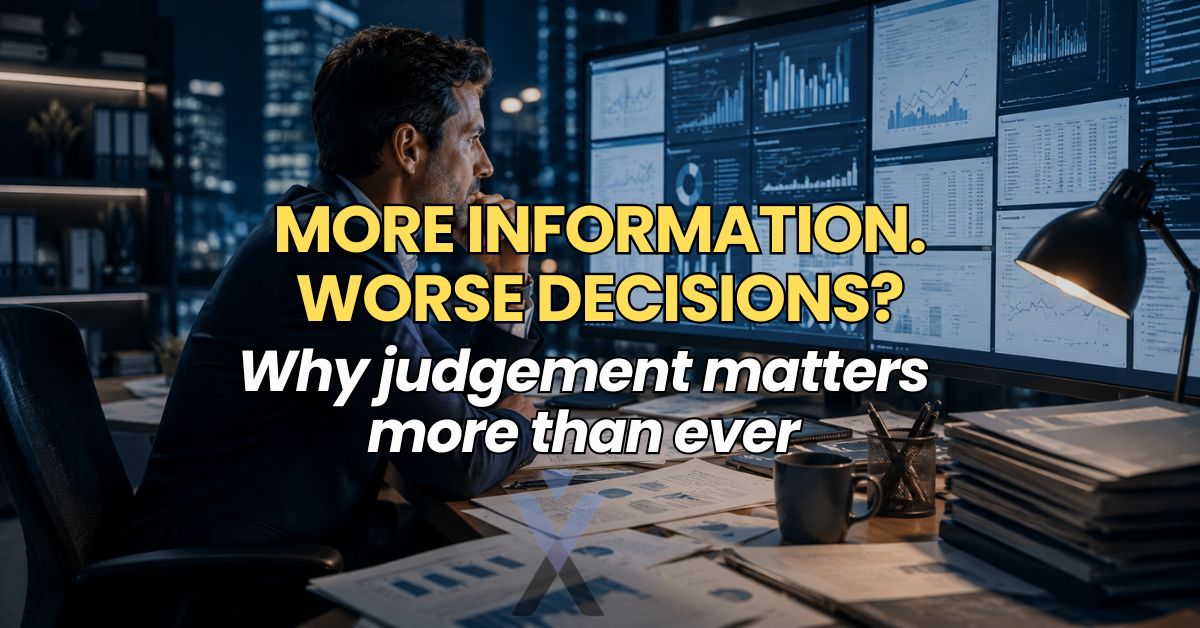
Yet despite having more answers than ever before, many leaders would quietly admit they have never faced more difficult decisions.
If information alone created better outcomes, modern workplaces should be thriving. Organisations should be making fewer mistakes. Leaders should feel more certain. Teams should be more aligned.
But that is not what many of us are experiencing.
Instead, we often find ourselves overwhelmed by competing priorities, conflicting advice, endless data and increasing complexity. The challenge is no longer finding answers.
The challenge is knowing which answers matter.
This is where judgement enters the conversation.
At Judgment Index™, we believe one of the most overlooked capabilities in modern leadership is not intelligence, expertise, qualifications or even experience.
It is judgement.
Because every decision we make is filtered through something much deeper than knowledge alone.
It is filtered through how we see the world.
The Difference Between Having Information and Exercising Judgement
Think about the best leader you have ever worked with.
Chances are they were not necessarily the smartest person in the room.
They may not have had the most qualifications, the highest IQ or the longest résumé.
Yet people trusted them.
Why?
Because when difficult situations emerged, they consistently demonstrated sound judgement.
They knew when to listen.
They knew when to act.
They knew when to challenge assumptions.
They knew when something did not feel right.
And perhaps most importantly, they knew how to weigh competing priorities without losing sight of what mattered most.
That is because thinking and judgement are not the same thing.
Thinking generates possibilities.
Judgement evaluates them.
Thinking gathers information.
Judgement determines which information deserves attention.
Thinking asks:
“What could we do?”
Judgement asks:
“What should we do?”
In a world increasingly driven by technology and information, this distinction may become one of the most important leadership capabilities of the future.
Why Smart People Sometimes Make Poor Decisions
This may sound counterintuitive, but intelligence alone does not guarantee good judgement.
In fact, some of history’s most significant business failures, political miscalculations and organisational disasters were led by highly intelligent people.
The issue was rarely a lack of information.
The issue was how that information was interpreted.
Harvard Business Review has consistently highlighted that effective leadership depends less on having all the answers and more on the quality of judgement applied when navigating uncertainty. In situations where information is incomplete, risks are evolving and consequences are unclear, judgement becomes the defining leadership capability.
Psychologists have spent decades studying how human beings make decisions.
What they have discovered is both fascinating and humbling.
We like to believe we make rational decisions.
In reality, our thinking is influenced by our assumptions, experiences, emotions, values, beliefs, relationships, pressures, biases and expectations.
In other words, we do not simply see reality.
We interpret reality.
And that interpretation influences every decision we make.
The Information Paradox
Research consistently shows that more information does not automatically lead to better decisions.
In fact, excessive information often creates decision fatigue, analysis paralysis and increased uncertainty.
Leaders can become trapped in endless cycles of gathering data while delaying action.
The result is that organisations become slower, opportunities are missed and accountability becomes blurred.
The most effective leaders recognise a critical truth:
There comes a point where the quality of judgement matters more than the quantity of information.
The challenge is not knowing everything.
The challenge is knowing when you know enough to act.
Why Judgement Matters More Than Ever
Martin Seligman and Gabriella Rosen Kellerman, authors of Tomorrowmind, describe today’s environment as increasingly characterised by volatility, uncertainty, complexity, ambiguity and anxiety.
The world many leaders grew up in no longer exists.
Markets change faster.
Technology evolves faster.
Workforces are more diverse.
Stakeholder expectations are higher.
Artificial Intelligence is transforming how decisions are made.
The volume of information confronting leaders is increasing exponentially.
Ironically, as information expands, certainty often declines.
The challenge facing modern leaders is no longer finding information.
The challenge is filtering signal from noise.
This is precisely where judgement becomes critical.
Because leadership today is less about having all the answers and more about making sense of competing information, conflicting viewpoints and uncertain futures.
The Human Side of Decision-Making
Gallup’s global workplace research consistently demonstrates that managers account for approximately 70% of the variance in employee engagement.
Think about that for a moment.
Seventy per cent.
Not strategy.
Not technology.
Not systems.
People.
More specifically, the quality of leadership decisions that shape people’s everyday experience at work.
Every conversation a leader has.
Every hiring decision.
Every promotion.
Every piece of feedback.
Every response to conflict.
Every decision about workload, wellbeing, accountability and recognition.
These moments may seem small in isolation.
Yet collectively they define culture.
And culture is simply the accumulated result of thousands of daily judgements.
The organisations that thrive are rarely those with the most information.
They are often those with leaders who consistently exercise sound judgement in situations where no perfect answer exists.
What Judgment Index™ Offers
This is where the Judgment Index™ provides a unique lens.
Rather than focusing solely on personality traits, technical skills or behavioural preferences, Judgment Index™ explores something deeper:
- How people evaluate the world around them
- How they prioritise
- How they assess risk
- How they respond under pressure
- How they make sense of complexity
- How they balance people, tasks and outcomes
- How they determine what matters
Because behind every action lies a judgement.
Behind every relationship lies a judgement.
Behind every leadership decision lies a judgement.
When we better understand judgement, we better understand human behaviour itself.
And when we understand human behaviour, we create greater opportunities for leadership, performance, wellbeing, safety and organisational success.
Final Reflection
Artificial Intelligence can provide answers.
Technology can provide information.
Data can provide insights.
But none of these can fully replace human judgement.
The future will not belong to the organisations with the most information.
It will belong to the organisations with the best judgement.
Because information can be copied.
Technology can be purchased.
Data can be collected.
But the ability to consistently interpret complexity, balance competing priorities, navigate uncertainty and make sound decisions remains profoundly human.
Artificial Intelligence may help us think faster.
Judgement helps us think better.
And that distinction may become one of the most important competitive advantages of the next decade.
So perhaps the most important leadership question is not:
“What are you thinking?”
But rather:
“How is your judgement shaping your thinking?”
References & Further Reading
- Judgment Index™ – The Judgment Index™ Framework
- Harvard Business Review – The Elements of Good Judgment
- Gallup – Employee Engagement and the Role of Managers
- Tomorrowmind – Martin Seligman & Gabriella Rosen Kellerman
- Psychology Today – How to Build Your Judgment and Critical Thinking
- 80,000 Hours Good Judgment: Why It Matters More Than Intelligence
Interested in learning more about how the Judgment Index can benefit your organisation? Request a sample report below!