
According to Gallup’s State of the Global Workplace reporting and APAC engagement trend analysis, India is experiencing one of the sharpest rises in quiet quitting across the region (Gallup: India Quiet Quitting vs Engagement Trend 2014–2025).
At first glance, this seems contradictory.
India’s younger workforce remains highly ambitious. Career drive is rising. Entrepreneurship is booming. Yet emotional disengagement continues spreading beneath the surface.
Australia faces a different version of the same problem.
Instead of silent disengagement, Australia is seeing increasing levels of active disengagement, employees emotionally detaching from leadership, culture, and organisational purpose altogether.
Different symptoms.
Same underlying issue:
Judgement misalignment under pressure.
And that’s the workforce challenge most organisations still fail to understand.
Quiet Quitting Is Not About Laziness
Quiet quitting is often misunderstood.
It is not:
- laziness
- lack of ambition
- weak work ethic
- entitlement
In most cases, quiet quitting is a psychological protection mechanism.
It happens when:
- effort no longer feels meaningful
- pressure exceeds coping capacity
- values become disconnected from work
- emotional exhaustion overrides motivation
- people lose trust that extra effort matters
This is why traditional engagement strategies often fail.
Free lunches, wellness programs, and motivational campaigns do not solve deeper judgement misalignment.
Because disengagement begins internally long before it becomes behaviourally visible.
India’s Workforce Shift Reveals a Larger APAC Trend
India’s workplace transformation reflects broader changes happening across APAC.
Younger employees increasingly want:
- purpose
- growth
- autonomy
- alignment
- psychological sustainability
They are willing to work hard.
But they are less willing to sacrifice wellbeing for organisations that fail to provide clarity, meaning, or leadership trust.
That distinction matters enormously.
For decades, many organisations operated under the assumption that pressure alone created performance.
Today’s workforce is proving the opposite.
Pressure without alignment destroys performance over time.
Australia Faces the Opposite Problem, But the Same Cause
India’s challenge is rising quiet quitting.
Australia’s challenge is rising active disengagement.
Employees are not merely withdrawing quietly.
Many are openly:
- emotionally disconnected
- cynical toward leadership
- exhausted by workplace pressure
- detached from organisational goals
This creates dangerous instability across:
- leadership teams
- frontline environments
- healthcare
- education
- corporate services
- technical industries
Yet most organisations still approach disengagement as a morale issue rather than a judgement issue.
That is the critical mistake.
Judgement Is the Hidden Driver Behind Engagement
Engagement is not created through motivation alone.
It is shaped by how people:
- think under pressure
- process uncertainty
- interpret leadership
- align with organisational values
- cope with stress
- maintain resilience
- solve problems
When judgement deteriorates:
- resilience weakens
- role clarity collapses
- conflict increases
- burnout accelerates
- engagement declines
This is why two employees can experience the same workplace completely differently.
One remains resilient.
The other disengages.
The difference often lies in judgement alignment.
Why Traditional Engagement Surveys Miss the Real Problem
Most engagement surveys measure outcomes.
They ask:
- “How satisfied are you?”
- “Would you recommend this workplace?”
- “Do you feel engaged?”
But they rarely measure:
- pressure response
- coping capacity
- resilience quality
- role fit
- values alignment
- judgement under stress
This means organisations often discover disengagement too late.
By the time survey scores decline:
- burnout has already formed
- leadership trust has weakened
- emotional fatigue has spread
- performance inconsistency is already visible
The Judgment Index™ addresses this gap directly.
How the Judgment Index™ Identifies Disengagement Early
The Judgment Index™ measures the underlying human performance drivers most organisations never assess.
It identifies:
- why disengagement begins
- how stress impacts decision-making
- where role alignment breaks down
- which leaders are vulnerable to burnout
- where values conflict exists
- how pressure affects judgement quality
This matters because disengagement is rarely sudden.
It develops progressively through:
- unresolved pressure
- emotional overload
- misaligned expectations
- declining resilience
- loss of meaning
The earlier organisations identify these patterns, the easier they are to correct.
The Leadership Consequences Are Massive
When judgement alignment deteriorates, leadership capability suffers rapidly.
Organisations begin experiencing:
- inconsistent decision-making
- emotional volatility
- declining accountability
- rising conflict
- trust erosion
- reactive management behaviour
In high-pressure environments, this becomes even more dangerous.
Leaders who operate under chronic pressure without adequate resilience eventually lose clarity, emotional regulation, and strategic effectiveness.
This is now becoming increasingly visible across both India and Australia.
The Future of Workforce Performance Is Psychological Alignment
The next era of workforce performance will not be driven by:
- productivity systems
- engagement perks
- motivational slogans
- superficial culture initiatives
It will be driven by psychological alignment.
Organisations that thrive will understand:
- how people make decisions under pressure
- what sustains resilience
- how values influence performance
- why role fit matters
- how judgement quality shapes leadership effectiveness
India’s quiet quitting crisis is not simply a warning sign.
It is an early indicator of where the future of work is heading globally.
Australia Must Act Before Disengagement Deepens Further
Australia still has a highly capable workforce.
But capability without alignment becomes unsustainable.
Without stronger judgement systems, organisations will continue facing:
- burnout
- disengagement
- leadership instability
- declining trust
- retention problems
- workforce fatigue
The organisations that adapt fastest will be the ones that stop measuring engagement superficially and start understanding the human judgement systems underneath performance.
Final Thought
India’s lesson is simple:
You do not fix disengagement by asking how people feel.
You fix it by understanding how they think.
And that requires a far deeper understanding of judgement, resilience, alignment, and human performance under pressure than traditional engagement models can provide.
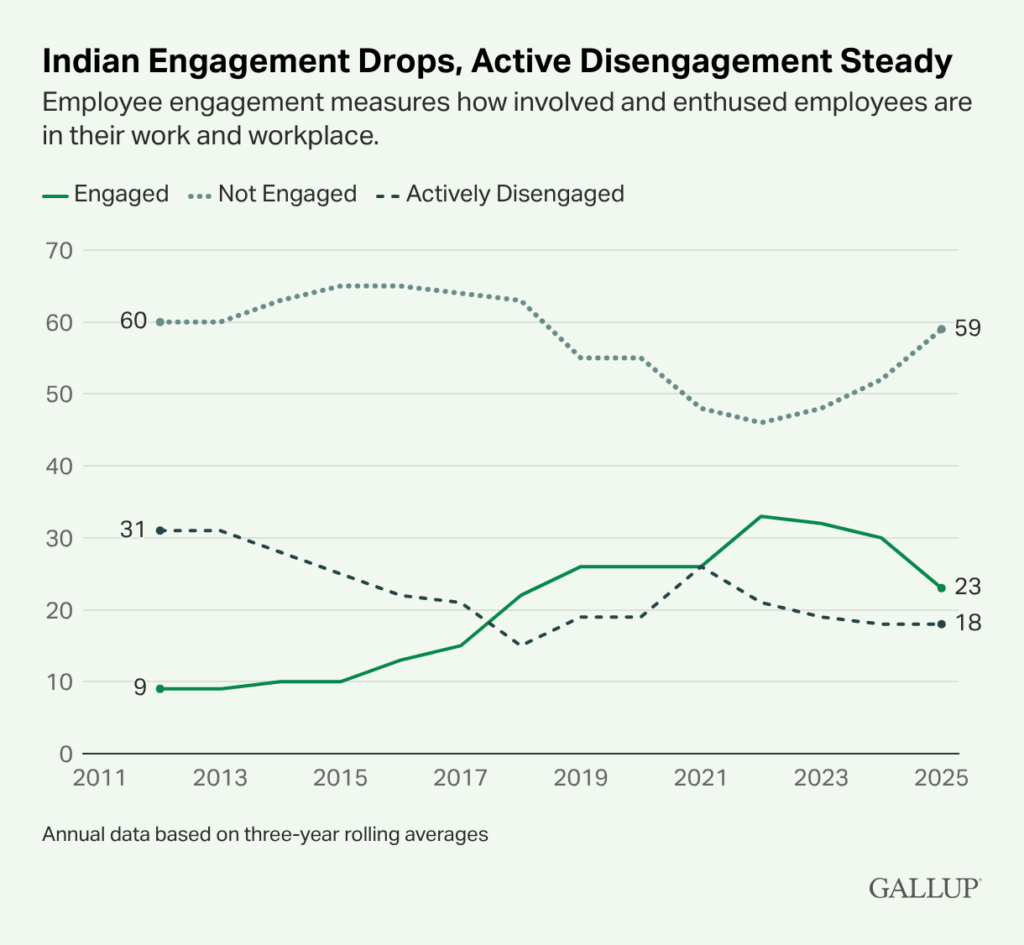
Engagement trend interpretation based on Gallup workplace reporting and APAC workforce analysis. I Source: Gallup,State of the Global Workplace 2025
If you want to reduce quiet quitting, strengthen leadership judgement, and build a workforce that stays engaged under pressure, the Judgment Index™ is your next strategic step.
Contact us at or request a sample report below.