

Why Most Organisations Don’t Actually Understand Their Leaders (and What Changes When They Do)
Most organisations believe they understand their people.
They have performance reviews.
They have engagement surveys.
They have competency frameworks.
They have succession plans.
But when you ask a simple question;
“Which of your leaders will succeed in a more complex role under real pressure, uncertainty, and change?”
The confidence often drops quickly.
Because most leadership systems measure outcomes, not underlying leadership capacity.
Performance reviews tell us what someone has achieved.
Competency frameworks tell us what someone can do.
But neither reliably explains how a leader will respond when conditions become more demanding, teams become more complex, or the stakes become higher.
This is where the Judgment Index™ (JI) Leadership Qualities Framework provides a fundamentally different perspective.
Rather than focusing solely on observable behaviours, the framework examines the underlying psychological, behavioural, relational, and cognitive drivers that shape leadership effectiveness.
It helps organisations understand not just what leaders do, but why they do it.
And more importantly, what is likely to happen next.
Why First Principles Matter
Most leadership failures are not caused by a lack of technical knowledge.
They are caused by deeper issues such as:
- Poor judgement under pressure
- Low self-awareness
- Weak relational trust
- Difficulty adapting to change
- Inconsistent execution
- Reduced resilience during stress
- Misaligned values and behaviours
These are not simply skills gaps.
They are capability gaps.
First-principles leadership assessment helps organisations answer questions such as:
- Why does this leader struggle during organisational change?
- Why does this team underperform despite having talented people?
- Why do some high performers fail after promotion?
- Why do succession plans repeatedly fall short?
By identifying the underlying drivers of leadership effectiveness, organisations gain insight into the root causes behind leadership performance rather than simply measuring outcomes.
Looking Beyond Leadership Scores
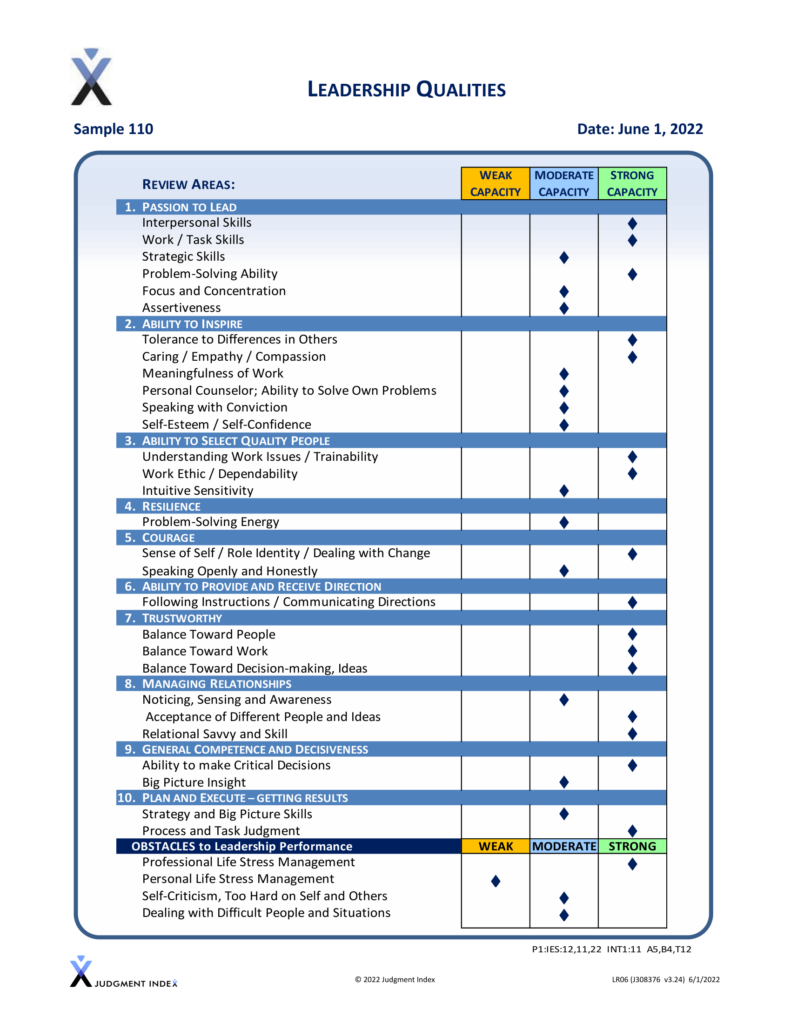
Most leadership assessments stop at the headline result.
A leader is described as resilient.
Another is viewed as trustworthy.
Someone else is considered inspirational.
While useful, these labels only tell part of the story.
The real value lies in understanding what creates those qualities.
The Leadership Qualities report is built on a series of Review Areas that measure the behaviours, attitudes, and tendencies that contribute to leadership success.
These underlying indicators provide a more complete understanding of how a leader is likely to perform when faced with complexity, ambiguity, and pressure.
Instead of asking:
“Is this person a good leader?”
The better question becomes:
“What factors are driving their leadership effectiveness?”
The Building Blocks of Effective Leadership
Strategic Thinking and Decision-Making
As leaders move into more senior roles, the ability to think strategically becomes increasingly important.
Strong leadership requires the ability to:
- See the bigger picture
- Balance competing priorities
- Navigate ambiguity
- Make sound decisions under pressure
The Leadership Qualities report examines review areas such as:
- Strategic Skills
- Big Picture Insight
- Problem-Solving Ability
- Ability to Make Critical Decisions
These measures help identify leaders who can move beyond day-to-day operational demands and contribute to long-term organisational success.
Because leadership is rarely limited by access to information.
More often, it is limited by judgement.
Relationship Management and Trust
Leadership is fundamentally about people.
The ability to build trust, manage relationships, and communicate effectively often determines whether teams thrive or struggle.
Many leadership problems are not capability problems.
They are relationship problems.
The framework evaluates areas such as:
- Interpersonal Skills
- Caring, Empathy and Compassion
- Acceptance of Different People and Ideas
- Relational Savvy and Skill
- Speaking Openly and Honestly
These indicators help organisations understand how leaders influence:
- Team engagement
- Psychological safety
- Collaboration
- Retention
- Workplace culture
Trust is not established through position or authority.
It is built through consistent behaviour over time.
Execution and Accountability
Many organisations are rich in ideas but poor in execution.
Strong leaders create clarity, accountability, and momentum.
The report examines areas such as:
- Work Ethic and Dependability
- Process and Task Judgement
- Following Instructions and Communicating Directions
- Focus and Concentration
These review areas help identify leaders who can:
- Deliver consistently
- Maintain standards
- Follow through on commitments
- Translate plans into results
Execution is often the difference between strategy that creates value and strategy that remains theoretical.
Resilience and Adaptability
Modern leadership requires the ability to remain effective under pressure.
Periods of change, uncertainty, and disruption place significant demands on leaders.
Some become stronger.
Others become overwhelmed.
The framework evaluates areas such as:
- Problem-Solving Energy
- Self-Esteem and Self-Confidence
- Sense of Self and Role Identity
- Professional Stress Management
- Personal Stress Management
These measures provide insight into how leaders respond when circumstances become difficult.
Resilience is not simply toughness.
It is the ability to maintain sound judgment, emotional stability, and effective performance when pressure increases.
Leadership Motivation and Influence
Technical competence alone does not create leadership effectiveness.
Leadership also requires energy, conviction, and the ability to influence others.
The framework explores areas such as:
- Meaningfulness of Work
- Speaking with Conviction
- Assertiveness
- Self-Confidence
Together, these indicators help determine whether a leader has the motivation and influence necessary to create followership.
People rarely follow a title.
They follow leaders they trust, respect, and believe in.
Identifying and Developing Talent
One of the most overlooked leadership capabilities is the ability to recognise potential in others.
Organisations do not scale because of individual leaders.
They scale because leaders build other leaders.
The report assesses areas such as:
- Intuitive Sensitivity
- Understanding Work Issues and Trainability
- Awareness and Observation Skills
- Tolerance to Differences in Others
These indicators provide insight into a leader’s ability to:
- Identify future talent
- Build strong teams
- Develop capability in others
- Strengthen succession pipelines
The quality of an organisation’s future leadership often depends on the talent decisions being made today.
Understanding Leadership Obstacles
Strong leadership capability can still be undermined by hidden obstacles.
The Leadership Qualities report identifies factors that may erode leadership effectiveness over time, including:
- Professional Life Stress Management
- Personal Life Stress Management
- Excessive Self-Criticism
- Difficulty Managing Challenging People and Situations
These obstacles are often invisible within traditional performance systems.
Yet they frequently explain why otherwise capable leaders struggle during periods of increased pressure.
Understanding these risks allows organisations to intervene early rather than reacting after performance declines.
Why the Group Dashboard Changes Everything
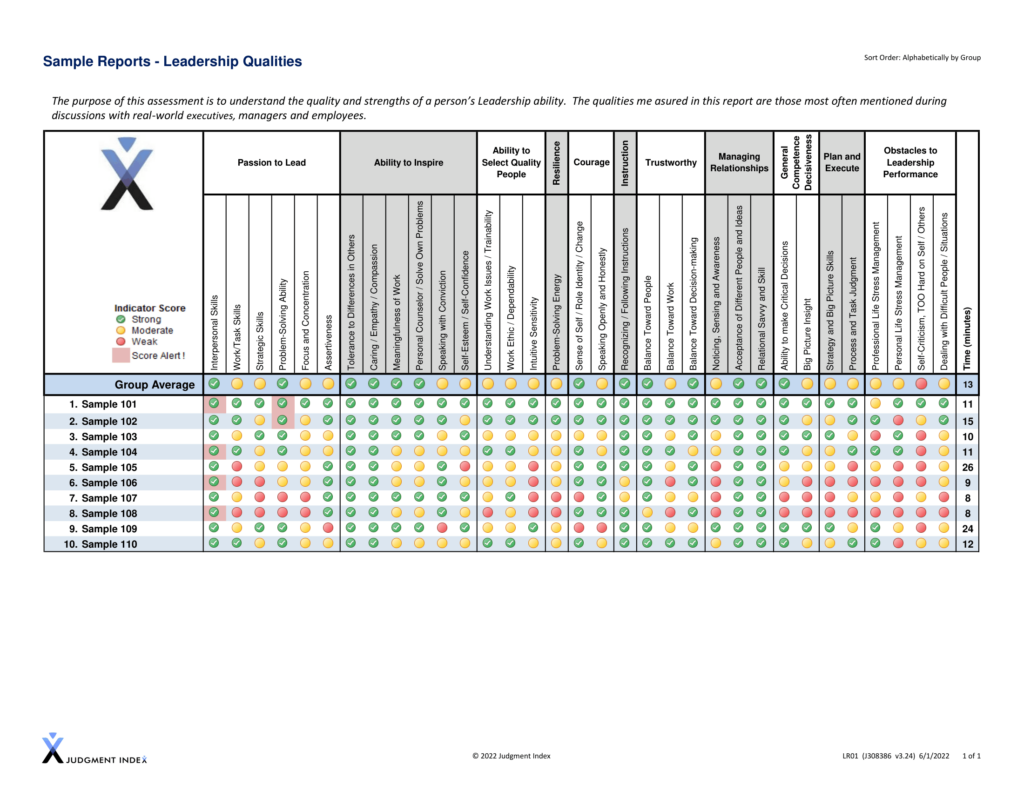
Most organisations assess leaders one person at a time.
The real strategic advantage comes from understanding leadership capability across the organisation as a whole.
The JI Leadership Group Dashboard provides a system-level view of leadership capacity.
Rather than focusing on individual leaders in isolation, it enables HR and executive teams to identify patterns across departments, leadership layers, and business units.
For example, organisations may discover:
- Strong relationship skills but weak strategic thinking
- High trustworthiness but low resilience
- Strong execution capability but poor succession readiness
- Leadership strengths concentrated in specific teams
- Emerging risks in key management groups
This allows organisations to move beyond assumptions and make evidence-based leadership decisions.
The result is greater clarity around:
- Leadership development priorities
- Succession planning
- Organisational resilience
- Change readiness
- Talent risk
- Future leadership capacity
Leadership intelligence becomes organisational intelligence.
The Strategic Value for HR and Executive Teams
The Leadership Qualities Report supports critical workforce decisions, including:
Reorganisation and Change
Identify which leaders have the resilience and adaptability to navigate complexity.
Succession Planning
Move beyond subjective “ready now” assessments and understand genuine leadership readiness.
Leadership Development
Target development efforts based on root-cause capability gaps rather than generic training programs.
Talent Selection and Promotion
Reduce promotion risk by understanding how individuals are likely to perform under increased responsibility.
Retention and Engagement
Identify leadership factors that may influence team performance, trust, and retention outcomes.
Final Thought
Most organisations do not lack data about their people.
They lack a reliable way to interpret leadership capability at its foundation.
The Judgment Index™ Leadership Qualities Report provides that missing layer.
By examining the underlying drivers of leadership effectiveness, organisations gain insight into not only what leaders are doing today, but how they are likely to perform tomorrow (see how Judgment Index™ works).
Because ultimately:
Performance tells you what happened.
Competency tells you what someone can do.
First principles tell you what is likely to happen next.
And for HR leaders, executives, and boards, that distinction can make all the difference.
➡️ Follow Us on LinkedIn!
☎️ Book a Discovery Call!
📜 Request a Sample Report!
Interested in learning more about how the Judgment Index can benefit your organisation? Request a sample report below!