
A recent Harvard Business Review article by Ruth Curran, Steve Patscot, and Edward Stadolnik examined an important question:
How do leaders actually reach the C-suite in S&P 500 companies?
Their conclusion challenges one of the most common assumptions about executive leadership.
“For ambitious executives, reaching the C-suite increasingly requires more than functional expertise.”
For many leaders, that statement deserves careful reflection.
For decades, career progression was often viewed as a straightforward path. Build technical expertise, become the best in your function, deliver results, and eventually leadership opportunities will follow.
The reality is more nuanced.
The research found that nearly 60% of C-suite leaders are promoted internally, with some executive functions approaching internal promotion rates of 80%.
This raises an important question:
If organisations have access to external talent, why do they consistently promote from within?
The answer is not simply expertise.
It is trust.
The Promotion Currency Most Leaders Overlook
When boards, CEOs, and executive teams evaluate leadership potential, they are assessing far more than technical capability.
They are asking questions such as:
- Can this person make sound decisions under pressure?
- How do they respond when information is incomplete?
- Do they demonstrate sound judgement in ambiguous situations?
- Can they balance competing stakeholder interests?
- Will others trust and follow their leadership?
In other words, they are evaluating judgement.
Technical expertise may earn a seat at the leadership table, but judgement determines who is invited into the room where enterprise-wide decisions are made.
The most successful executives are not simply recognised for what they know.
They are trusted for how they think.
The Functional Leadership Trap
The HBR article highlights another challenge many leaders face:
“C-suite functional leaders who lack strategic influence risk becoming pigeonholed.”
This occurs more often than many organisations realise.
We’ve all encountered examples:
- The CFO who is viewed solely as the financial expert.
- The CIO who is consulted only on technology matters.
- The CHRO who is brought in only when people issues arise.
- The General Counsel who is seen exclusively through a risk-management lens.
Each may be highly competent.
Each may be respected.
Yet many struggle to progress because their influence remains confined to their functional expertise.
The leaders who advance further are those who contribute meaningfully to broader organisational decisions.
They demonstrate the ability to think beyond their discipline and consider the organisation as a whole.
They become enterprise leaders rather than functional leaders.
Why Judgement Has Become a Strategic Leadership Capability
Modern organisations operate in environments characterised by increasing uncertainty.
Markets shift rapidly.
Technology evolves continuously.
Workforces are becoming more diverse and distributed.
Stakeholder expectations continue to expand.
In this environment, expertise alone has limitations.
Past experience does not always provide the answers.
Technical knowledge cannot solve every challenge.
What matters increasingly is the ability to make sound decisions when certainty is unavailable.
This is the essence of executive judgement.
Judgement allows leaders to:
- Navigate ambiguity.
- Balance short-term and long-term priorities.
- Evaluate risk appropriately.
- Challenge assumptions.
- Adapt their thinking as circumstances change.
- Make decisions despite incomplete information.
The higher leaders progress, the more judgement becomes their primary leadership tool.
The Self-Awareness Advantage
Perhaps the most valuable insight from the HBR article concerns what leaders should do long before they aspire to the C-suite.
Curran, Patscot, and Stadolnik recommend that leaders:
“Do an annual self-evaluation with brutal candor, looking at your strengths, gaps, missing experiences and the decisions you avoid.”
This advice is remarkably powerful.
Because leadership effectiveness is rarely limited by what we know.
More often, it is constrained by what we fail to recognise about ourselves.
The decisions we postpone.
The conversations we avoid.
The assumptions we never challenge.
The habits we mistake for strengths.
The blind spots we cannot see.
And this presents a fundamental challenge.
You cannot identify all of your own blind spots by yourself.
The Johari Window and the Hidden Dimensions of Leadership
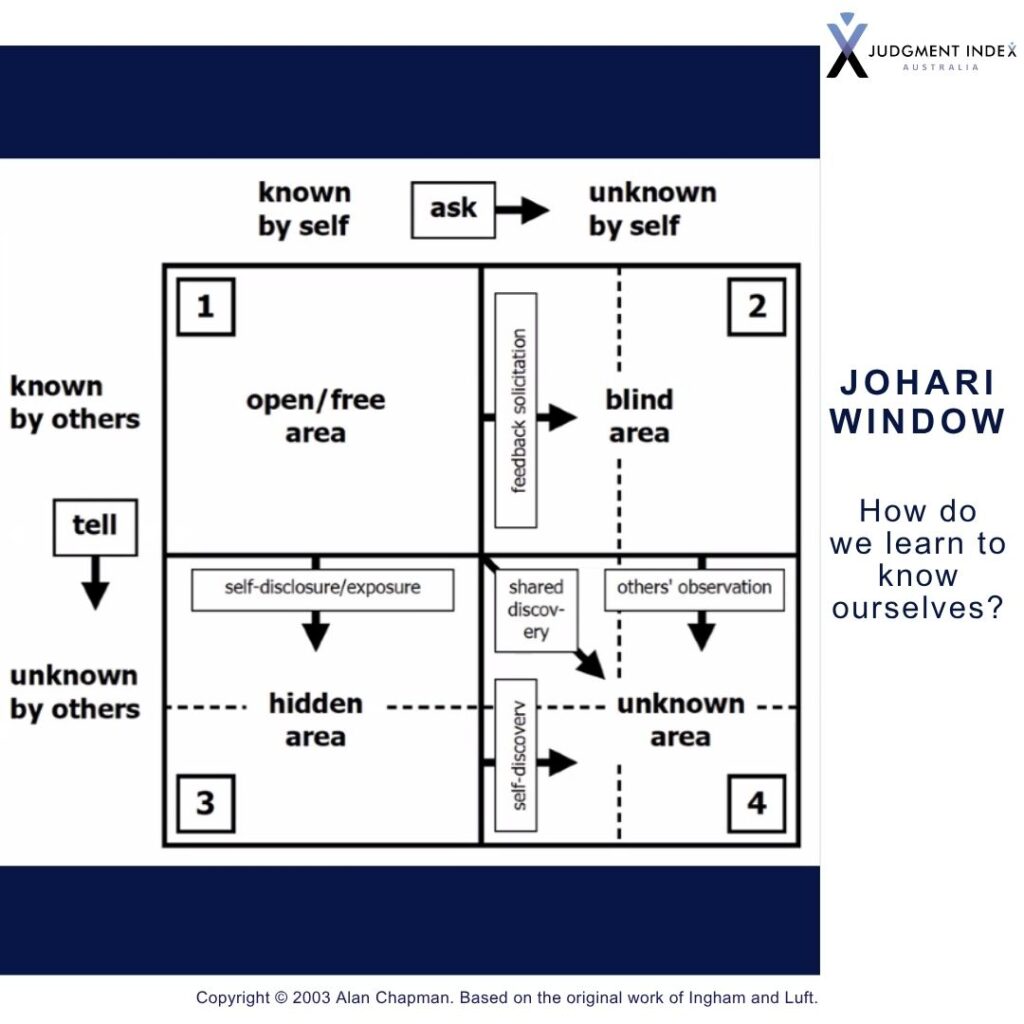
Psychologists Joseph Luft and Harrington Ingham introduced the Johari Window in 1955 as a framework for understanding self-awareness.
The model divides personal awareness into four areas:
The Open Area
What both you and others know about you.
The Hidden Area
What you know about yourself but others do not.
The Blind Spot Area
What others can see but you cannot.
The Unknown Area
What neither you nor others currently recognise.
For leaders, the blind spot area is particularly important.
Blind spots often influence:
- Decision-making quality.
- Communication effectiveness.
- Leadership presence.
- Team engagement.
- Organisational trust.
Without feedback, blind spots remain hidden.
Without awareness, improvement becomes difficult.
And without improvement, leadership effectiveness eventually plateaus.
Why Feedback Alone Is Not Enough
Many organisations attempt to address self-awareness through traditional feedback mechanisms.
While valuable, feedback alone often focuses on behaviours rather than judgement.
It tells leaders what happened.
It does not always explain how their thinking processes contributed to those outcomes.
Modern leadership development requires a deeper understanding of:
- How leaders make decisions.
- How they assess risk.
- How they interpret information.
- How they respond to uncertainty.
- How others experience their judgement in practice.
This is where judgement-focused assessment becomes increasingly valuable.
The Judgment Index™ Perspective
The premise behind the Judgment Index™ is straightforward.
Leadership success is not determined solely by intelligence, expertise, or experience.
It is shaped by the quality of a leader’s judgement.
By combining structured feedback with judgement-based assessment, organisations gain deeper insight into how leaders think, decide, and influence others.
This process helps uncover:
- Hidden strengths.
- Development opportunities.
- Leadership blind spots.
- Decision-making patterns.
- Areas where executive readiness can be accelerated.
Most importantly, it creates the self-awareness necessary for meaningful growth.
The Real Leadership Question
The question is not whether leaders have blind spots.
Every leader does.
The question is whether those blind spots will be discovered through deliberate development—or through costly mistakes.
The organisations that consistently outperform their peers understand this distinction.
They do not focus solely on developing skills.
They invest in developing judgement.
They build self-awareness.
They create feedback-rich cultures.
They help leaders learn faster than the challenges they face.
For CEOs, CHROs, board members, and executive teams, the question is worth considering:
When was the last time your leaders received genuinely candid insight into how their judgement, decision-making, and leadership are experienced by others?
If the answer is unclear, there may be opportunities hidden in the blind spots.
About the Judgment Index™
The Judgment Index™ helps organisations measure and develop one of the most important predictors of executive effectiveness: judgement. By combining leadership assessment, structured feedback, and decision-making analysis, the Judgment Index™ provides leaders with deeper insight into how their judgement is experienced by others and where development opportunities exist.
References
- Curran, R., Patscot, S., & Stadolnik, E. (2026, May 22). How People Actually Get to the C-Suite in S&P 500 Companies. Harvard Business Review.
- Luft, J., & Ingham, H. (1955). The Johari Window: A Graphic Model of Interpersonal Awareness. Proceedings of the Western Training Laboratory in Group Development. Johari Window Official Resource.
Further Reading
- Harvard Business Review – Leadership Development Collection
- Harvard Business Review – Leadership and Managing People
- Center for Creative Leadership – Self-Awareness and Leadership Development
- MindTools – Johari Window Model Explained
➡️ Follow Us on LinkedIn!
☎️ Book a Discovery Call!
📜 Request a Sample Report!
Interested in learning more about how the Judgment Index can benefit your organisation? Request a sample report below!