
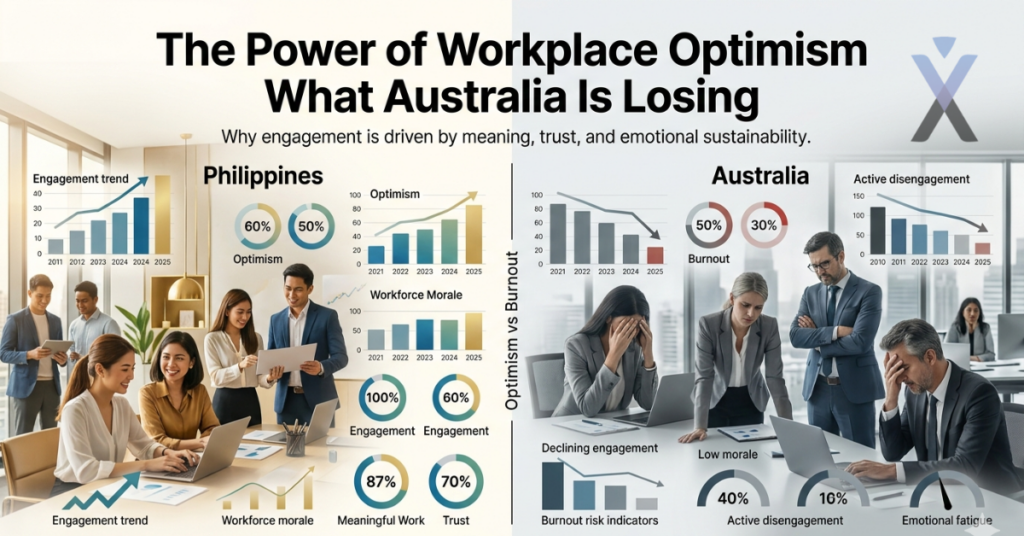
The Philippines continues to stand out across APAC for one powerful reason:
Optimism.
While many countries battle burnout, disengagement, and emotional exhaustion, Filipino workplaces consistently demonstrate high levels of:
- energy
- morale
- relational connection
- workplace optimism
- emotional resilience
Australia is heading in the opposite direction.
Active disengagement is rising. Optimism is declining. Emotional fatigue is becoming increasingly visible across leadership and frontline environments.
So what explains the difference?
The answer is not simply personality or culture.
It is alignment.
The Philippines demonstrates what happens when people feel emotionally connected to their work, leadership, and contribution.
And Australia has far more to learn from this than many organisations realise.
Optimism Is Not Soft — It Is Strategic
Many leaders underestimate the business value of optimism.
They treat it as emotional tone rather than organisational capability.
But optimism directly affects:
- resilience
- adaptability
- problem-solving
- collaboration
- leadership stability
- coping under pressure
People who believe their work matters are more likely to:
- persist through challenges
- maintain emotional regulation
- engage relationally
- contribute creatively
- remain psychologically resilient
This is one of the hidden advantages visible in the Philippines workforce environment.
The Modern Workforce Needs Meaning
One of the strongest drivers behind workplace optimism is meaningfulness.
Employees increasingly want work that feels:
- purposeful
- connected
- human
- emotionally relevant
- aligned with personal values
This is especially important under pressure.
Meaning acts as a resilience stabiliser.
Without meaning:
- stress feels heavier
- fatigue accelerates
- burnout develops faster
- motivation weakens
- disengagement spreads
Australia’s workforce challenges increasingly reflect a decline in this emotional connection to work itself.
Australia’s Engagement Decline Is Also a Meaning Crisis
Many Australian organisations remain operationally strong.
But emotionally, employees are increasingly detached.
Workers often report:
- emotional exhaustion
- lack of fulfilment
- constant urgency
- low optimism
- unclear purpose
- leadership distrust
This creates environments where people continue performing technically while disconnecting psychologically.
That distinction is critical.
Because emotional disengagement eventually weakens:
- innovation
- collaboration
- leadership trust
- retention
- resilience
- long-term performance
Why Emotional Energy Matters More Than Ever
High-performing workplaces are not built on pressure alone.
They require emotional sustainability.
The Philippines demonstrates the power of workforce environments where:
- relational trust remains strong
- contribution feels valued
- emotional connection exists
- people feel psychologically seen
This creates higher workforce energy.
And workforce energy directly affects:
- engagement
- creativity
- adaptability
- team cohesion
- resilience under stress
Low-energy workplaces eventually become reactive, fatigued, and emotionally unstable.
Judgement Determines Whether Pressure Creates Growth or Burnout
Pressure itself is not always harmful.
The key variable is judgement quality under pressure.
Employees with strong judgement alignment are better able to:
- regulate emotions
- prioritise effectively
- maintain resilience
- communicate clearly
- adapt strategically
- sustain performance
Employees without that alignment eventually experience:
- emotional overload
- cognitive fatigue
- burnout
- disengagement
- reactive decision-making
This is why engagement and optimism cannot be separated from judgement systems.
The Problem With Traditional Engagement Models
Most engagement surveys measure emotional outcomes after problems already exist.
They identify:
- dissatisfaction
- frustration
- declining morale
But they rarely measure the deeper performance drivers underneath those symptoms.
That includes:
- coping capacity
- resilience quality
- values alignment
- emotional sustainability
- pressure tolerance
- role fit
- judgement stability
This leaves organisations reacting too late.
By the time disengagement becomes visible, trust and resilience may already be severely weakened.
How the Judgment Index™ Identifies Engagement Risks Early
The Judgment Index™ measures the human performance variables that shape long-term engagement and resilience.
It identifies:
- where values support performance
- where pressure is weakening judgement
- where burnout risks are forming
- where leadership instability exists
- where emotional sustainability is declining
- where disengagement is developing early
This allows organisations to intervene proactively rather than reactively.
That difference is enormous.
Because prevention is always more effective than recovery once burnout spreads organisationally.
Why Australia Must Rebuild Emotional Sustainability
Australia’s workforce challenge is not a lack of intelligence or capability.
It is a growing lack of emotional sustainability.
Many employees operate in environments characterised by:
- chronic pressure
- emotional depletion
- leadership inconsistency
- urgency culture
- psychological fatigue
Over time, these conditions weaken organisational resilience.
And resilience is now one of the most important determinants of long-term workforce performance.
The Philippines demonstrates what happens when optimism, meaning, and relational energy remain strong.
The Future Workplace Will Reward Human Alignment
The future of work will increasingly reward organisations that understand:
- emotional resilience
- psychological alignment
- leadership trust
- meaningful contribution
- sustainable performance
- judgement under pressure
The most successful organisations will not simply optimise productivity.
They will optimise human performance systems.
That is where workforce advantage now lives.
The Philippines offers Australia an important reminder:
People perform better when they feel connected to meaning, contribution, and human alignment.
Optimism is not accidental.
It is built through:
- trust
- values alignment
- emotional sustainability
- resilient leadership
- psychologically healthy workplaces
And the organisations that build those environments will outperform the ones still relying purely on pressure-driven performance models.
If you want to lift optimism, strengthen resilience, and improve engagement across your workforce, the Judgment Index™ is your next strategic step.
➡️ Follow Us on LinkedIn!
☎️ Book a Discovery Call!
📜 Request a Sample Report!
Interested in learning more about how the Judgment Index can benefit your organisation? Request a sample report below!