
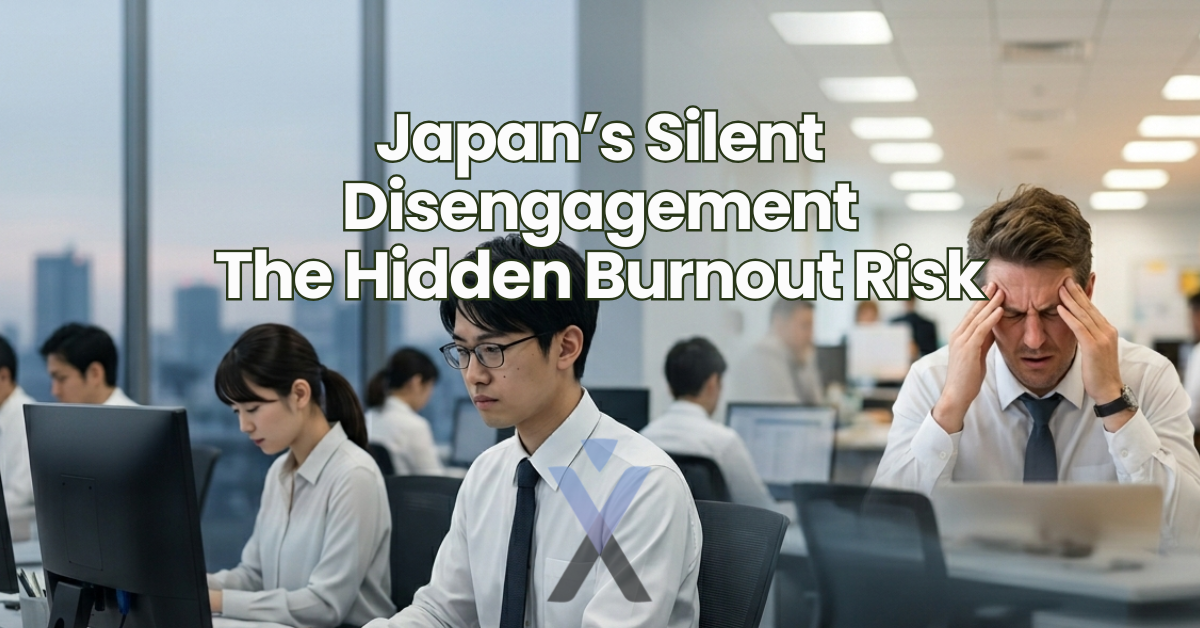
Japan presents one of the most fascinating workforce paradoxes in the world.
It consistently delivers:
- operational excellence
- extraordinary discipline
- high consistency
- global productivity leadership
- strong organisational reliability
Yet despite these strengths, Japan continues to report some of the lowest employee engagement levels in APAC.
Australia sits at the opposite end of the spectrum.
Australian workplaces often show:
- higher emotional expressiveness
- greater workplace flexibility
- stronger openness
- more visible feedback cultures
Yet burnout, active disengagement, and emotional fatigue continue accelerating.
Two different workforce models.
One shared problem:
Judgement under pressure.
Japan demonstrates the risks of silent disengagement.
Australia demonstrates the risks of visible disengagement.
Both reveal why traditional engagement models are no longer sufficient for modern workforce performance.
Discipline Alone Does Not Create Engagement
Japan has long been admired for its:
- precision
- reliability
- consistency
- work ethic
- accountability
But discipline and engagement are not the same thing.
A workforce can remain highly productive while becoming emotionally disconnected from the work itself.
This is the danger of silent disengagement.
Employees continue performing outwardly while internally experiencing:
- emotional exhaustion
- psychological withdrawal
- low motivation
- suppressed stress
- declining emotional connection
These issues often remain hidden because productivity itself masks the underlying strain.
Silent Disengagement Is Harder to Detect
One of the greatest organisational risks is disengagement that remains invisible.
Employees still:
- meet deadlines
- attend meetings
- complete tasks
- maintain professionalism
Yet internally:
- resilience declines
- emotional fatigue grows
- trust weakens
- meaning erodes
- pressure accumulates
This creates fragile organisational systems.
Because once resilience eventually collapses, recovery becomes significantly harder.
Japan demonstrates this risk clearly.
And Australia is beginning to experience its own version of the same problem.
Australia’s Challenge Is More Visible, But Equally Dangerous
Unlike Japan, Australian disengagement tends to appear more openly.
Employees increasingly report:
- burnout
- emotional exhaustion
- leadership distrust
- workplace cynicism
- declining morale
- psychological fatigue
This creates what Gallup describes as active disengagement.
The consequences are widespread:
- lower retention
- inconsistent performance
- rising absenteeism
- emotional instability
- weaker collaboration
- declining organisational trust
Both silent and visible disengagement stem from similar psychological foundations:
- pressure overload
- weak alignment
- poor resilience systems
- values disconnection
- judgement deterioration
Why Judgement Under Pressure Matters
Pressure itself is not the core problem.
The real issue is how pressure affects judgement quality.
Under prolonged stress, people experience:
- cognitive fatigue
- emotional dysregulation
- narrowed thinking
- reactive behaviour
- declining resilience
- impaired decision-making
This affects:
- leaders
- teams
- culture
- communication
- collaboration
- long-term performance
The Judgment Index™ focuses specifically on how people think, cope, and perform under pressure.
That is where disengagement truly begins.
Japan Reveals the Cost of Emotional Suppression
One major lesson Australia can learn from Japan is the long-term impact of emotional suppression in workplaces.
High-discipline cultures often unintentionally discourage:
- emotional transparency
- vulnerability
- psychological recovery
- open stress communication
Over time, this creates hidden pressure accumulation.
Employees become increasingly disconnected from:
- purpose
- meaning
- emotional sustainability
- personal wellbeing
This is why engagement cannot be measured purely through productivity.
People may still perform while internally deteriorating psychologically.
Australia Faces a Different Psychological Risk
Australian organisations often encourage openness more than traditional Japanese workplaces.
But openness without structure can create instability.
Many Australian workplaces now struggle with:
- unclear expectations
- inconsistent leadership
- urgency culture
- emotional overload
- role ambiguity
- chronic pressure
This weakens judgement stability under stress.
And when judgement weakens:
- engagement declines
- trust erodes
- resilience collapses
- burnout accelerates
Japan’s challenge is hidden emotional suppression.
Australia’s challenge is visible emotional overload.
Both require deeper leadership intelligence.
Why Traditional Engagement Surveys Miss Both Problems
Most engagement tools only measure surface-level sentiment.
They identify:
- satisfaction
- morale
- motivation
- workplace happiness
But they rarely measure:
- coping capacity
- emotional sustainability
- judgement quality
- pressure resilience
- burnout risk
- role alignment
This means organisations often fail to detect disengagement until performance problems become severe.
The Judgment Index™ addresses this gap directly.
How the Judgment Index™ Identifies Hidden Workforce Risk
The Judgment Index™ measures the deeper human performance systems that shape long-term engagement and resilience.
It identifies:
- where discipline masks disengagement
- where pressure is weakening judgement
- where burnout risk is forming
- where role fit is misaligned
- where leadership stability is deteriorating
- where emotional sustainability is declining
This gives organisations earlier visibility into workforce risk before engagement collapse becomes obvious.
That changes how leaders manage performance entirely.
The Future Workplace Requires Sustainable Performance
The modern workplace can no longer rely on:
- pressure-driven productivity
- emotional suppression
- constant urgency
- unsustainable work intensity
Long-term workforce performance now depends on:
- resilience
- emotional sustainability
- judgement quality
- alignment
- psychological recovery
- leadership stability
Japan’s workforce demonstrates both the power and danger of discipline without emotional sustainability.
Australia demonstrates the danger of emotional overload without structural resilience.
Both countries reveal why the future of leadership must become more psychologically intelligent.
Final Thought
Japan’s workforce model offers Australia an important warning:
Productivity does not always equal engagement.
A workforce can appear functional while resilience quietly deteriorates underneath.
And once judgement collapses under prolonged pressure, burnout and disengagement become inevitable.
The organisations that thrive in the future will not simply drive performance harder.
They will build systems that strengthen human judgement, emotional sustainability, and resilience under pressure.
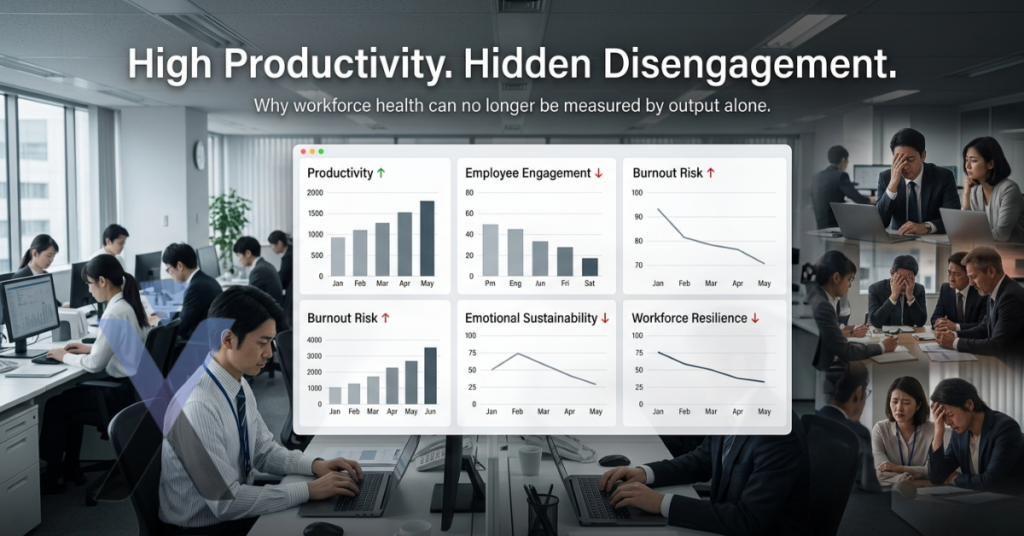
Workforce trend insights referenced from Gallup’s State of the Global Workplace 2025. I Analysis and interpretation independently developed by JIAU.
Reference Links:
- Gallup Workplace Insights
https://news.gallup.com/topic/workplace.aspx - Gallup Global Employee Engagement Data
https://www.gallup.com/394373/indicator-employee-engagement.aspx - Gallup State of the Global Workplace Report
https://www.gallup.com/workplace/349484/state-of-the-global-workplace.aspx
If you want to eliminate both silent and active disengagement, strengthen leadership resilience, and improve judgement under pressure, the Judgment Index™ is your next strategic step.
➡️ Follow Us on LinkedIn!
☎️ Book a Discovery Call!
📜 Request a Sample Report!
Interested in learning more about how the Judgment Index can benefit your organisation? Request a sample report below!