
Over the past decade, Indonesia has quietly achieved one of the most significant employee engagement improvements in Southeast Asia.
While many developed economies struggle with burnout, disengagement, and workplace fatigue, Indonesia has steadily strengthened workforce optimism, alignment, and organisational commitment.
Australia, meanwhile, remains stuck.
Engagement levels have stagnated. Active disengagement is rising. Burnout continues accelerating across leadership and frontline roles.
So what is Indonesia doing differently?
The answer is not simply economic growth.
It is alignment.
Indonesia demonstrates what happens when leadership, values, purpose, and judgement begin operating in harmony.
And for Australian organisations facing rising workforce instability, the lessons could not be more important.
Engagement Growth Is Never Accidental
Employee engagement does not rise randomly.
It grows when people feel:
- connected to purpose
- psychologically supported
- aligned with leadership
- emotionally invested in outcomes
- capable of coping under pressure
Indonesia’s steady rise reflects deeper structural and psychological shifts happening within its workforce culture.
Over time, organisations have increasingly recognised the importance of:
- values-driven leadership
- stronger manager capability
- clearer communication
- relational trust
- team cohesion
- emotional connection to work
This matters because sustainable engagement is never purely operational.
It is deeply human.
Australia’s Engagement Problem Is Becoming Structural
Australia’s workforce challenges are becoming increasingly difficult to ignore.
Many organisations are now experiencing:
- rising active disengagement
- emotional exhaustion
- leadership fatigue
- declining optimism
- retention instability
- workplace cynicism
Employees still show capability.
But capability alone is no longer enough to sustain long-term performance.
Increasingly, Australian workers feel disconnected from:
- organisational purpose
- leadership direction
- workplace meaning
- psychological sustainability
And when meaning disappears, engagement eventually follows.
Indonesia Shows the Power of Values Alignment
One of Indonesia’s strongest workplace advantages is the increasing alignment between values and work identity.
Employees perform better when:
- work reflects personal values
- leadership feels authentic
- contribution feels meaningful
- effort feels recognised
- organisational goals feel shared
This creates emotional investment.
And emotional investment drives resilience under pressure.
The modern workforce no longer separates performance from meaning.
People increasingly want both.
That shift is reshaping engagement across APAC.
Why Judgement Matters More Than Motivation
Many organisations still attempt to improve engagement through motivation-based initiatives.
But motivation fluctuates.
Judgement determines sustainability.
Judgement influences how employees:
- cope under stress
- interpret workplace pressure
- solve problems
- regulate emotions
- adapt to uncertainty
- collaborate with others
- maintain resilience
When judgement remains stable under pressure, engagement becomes far more sustainable.
When judgement collapses, disengagement spreads quickly.
This is the hidden workforce dynamic many organisations still fail to measure.
The Leadership Difference Behind Indonesia’s Rise
Manager capability plays an enormous role in workforce engagement.
Indonesia’s rise increasingly reflects stronger leadership behaviours around:
- communication
- empathy
- relational trust
- clarity
- emotional support
- team alignment
Employees rarely disengage solely because of workload.
More often, they disengage because pressure is poorly managed.
Under ineffective leadership:
- stress compounds
- trust erodes
- clarity disappears
- emotional fatigue increases
- resilience weakens
Strong leadership stabilises judgement under pressure.
Weak leadership accelerates disengagement.
Why Traditional Engagement Surveys Are No Longer Enough
Most engagement tools focus on surface-level emotional reporting.
They ask employees:
- how satisfied they feel
- whether they would recommend the workplace
- whether they feel motivated
But they rarely measure the underlying psychological systems driving those outcomes.
That includes:
- resilience quality
- judgement under stress
- coping capacity
- pressure tolerance
- values alignment
- role fit
- burnout vulnerability
This creates a dangerous blind spot.
Because by the time engagement scores visibly decline, the deeper organisational damage has often already formed.
How the Judgment Index™ Identifies Risk Earlier
The Judgment Index™ focuses on the human performance variables traditional engagement tools miss entirely.
It measures:
- judgement quality
- pressure resilience
- values alignment
- burnout risk
- role fit accuracy
- relational capability
- strategic insight
- emotional sustainability
This allows organisations to identify disengagement risks before they become visible performance problems.
That changes leadership decision-making dramatically.
Instead of reacting to burnout after it spreads, organisations can identify where pressure is already weakening judgement and alignment.
Australia’s Workforce Future Depends on Alignment
Australian organisations remain highly capable operationally.
But operational strength without psychological alignment creates fragility.
Increasingly, employees feel:
- emotionally overloaded
- disconnected from purpose
- uncertain about leadership
- exhausted by ambiguity
- pressured without recovery
These environments slowly erode workforce resilience.
And resilience is now one of the most important competitive advantages any organisation can build.
Indonesia’s rise demonstrates what becomes possible when organisations prioritise:
- meaning
- values
- alignment
- leadership quality
- emotional sustainability
The Future of Performance Will Be Human-Centred
The next decade of organisational success will not be determined solely by:
- technology
- automation
- productivity systems
- operational efficiency
It will increasingly depend on:
- judgement quality
- resilience
- leadership stability
- emotional sustainability
- relational intelligence
- psychological alignment
This is why traditional engagement models are becoming insufficient.
The future workplace requires deeper human performance intelligence.
Final Thought
Indonesia’s engagement growth offers a powerful lesson for Australia.
Engagement rises when:
- values align
- leadership stabilises pressure
- work feels meaningful
- judgement remains strong under stress
The organisations that understand this earliest will build the most resilient workforces in the future economy.
Because sustainable performance is no longer just about what people do.
It is about how they think, cope, align, and perform under pressure.
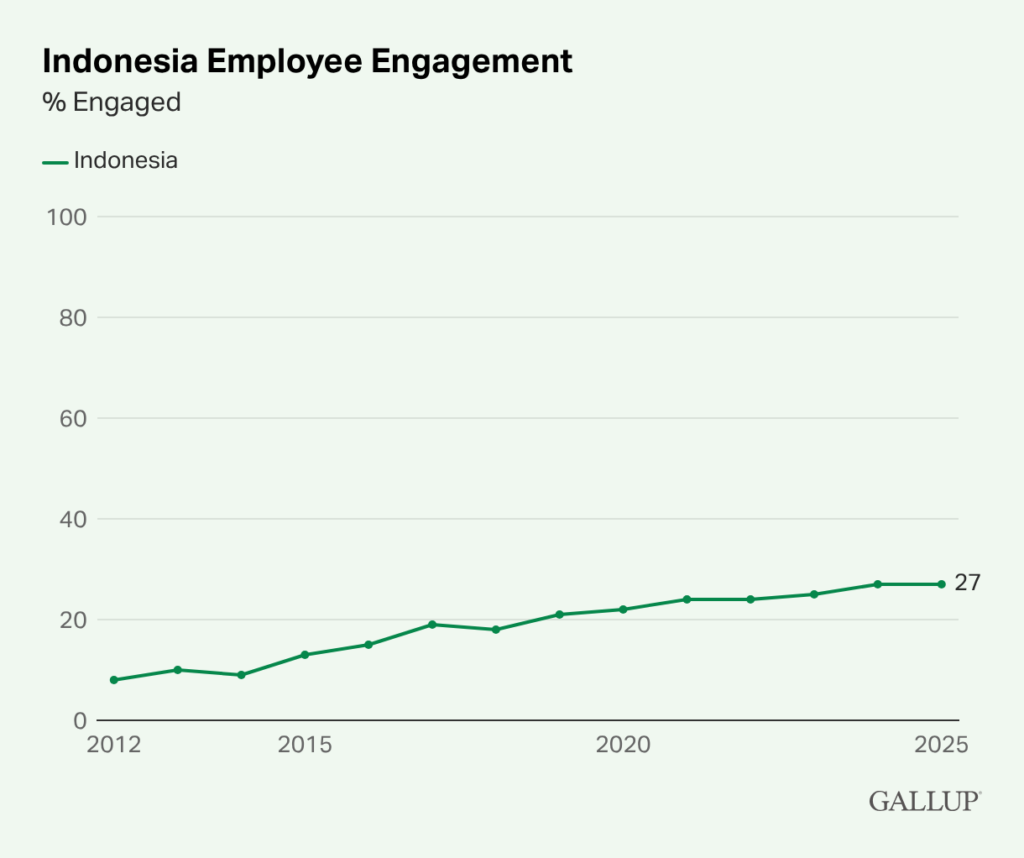
Gallup: Indonesia Engagement Growth (2014–2025) I Source: Gallup, State of the Global Workplace 2025
If you want engagement growth, the Judgment Index™ is the most precise starting point for building resilient, aligned, high-performance teams.