
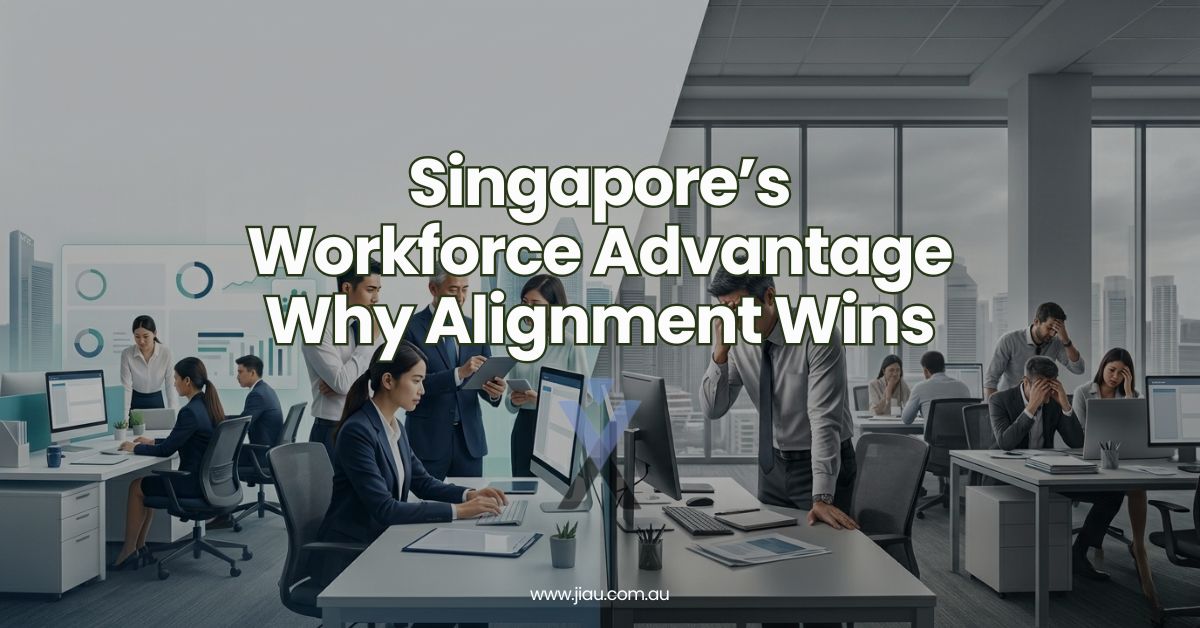
Singapore consistently outperforms most of APAC in workplace engagement, organisational clarity, and leadership consistency.
Australia continues moving in the opposite direction.
Despite strong talent, high education levels, and advanced industries, Australian workplaces are experiencing:
- rising active disengagement
- growing burnout
- declining optimism
- leadership fatigue
- increasing emotional exhaustion
Why?
The answer is not cultural.
It is structural.
Singapore demonstrates what happens when judgement, expectations, leadership, and organisational alignment operate together coherently.
And Australia has far more to learn from that model than most leaders realise.
Singapore’s Advantage Is Not About Working Harder
Singapore is often stereotyped as simply disciplined or highly driven.
But discipline alone does not create sustainable engagement.
What Singapore demonstrates exceptionally well is clarity.
Employees perform better when they clearly understand:
- expectations
- accountability
- leadership direction
- organisational priorities
- role responsibilities
- decision-making structures
This reduces one of the largest drivers of workplace stress:
Ambiguity.
Ambiguity Is Quietly Destroying Australian Workplaces
Many Australian organisations unintentionally operate in environments of chronic uncertainty.
Employees are often expected to:
- manage conflicting priorities
- absorb unclear leadership direction
- operate without role clarity
- multitask constantly
- adapt emotionally under pressure
Over time, this creates cognitive overload.
And cognitive overload weakens judgement quality.
The consequences appear everywhere:
- inconsistent leadership
- emotional exhaustion
- burnout
- disengagement
- declining trust
- reactive decision-making
Most engagement strategies fail because they focus on morale instead of judgement structure.
Singapore’s Workforce Model Is Built on Alignment
Singapore’s high-performance culture works because organisational systems reinforce alignment.
That includes:
- leadership consistency
- operational clarity
- structured accountability
- pressure management
- role definition
- decision precision
People generally cope better under pressure when:
- expectations are predictable
- leadership remains stable
- accountability is clear
- systems reduce unnecessary friction
This creates stronger judgement under pressure.
And stronger judgement drives sustainable performance.
Why Judgement Matters More Than Engagement
Most organisations still treat engagement as the primary workforce metric.
But engagement is an outcome; not the cause.
The deeper driver is judgement quality.
Judgement shapes:
- resilience
- emotional regulation
- strategic thinking
- adaptability
- collaboration
- problem-solving
- leadership stability
When judgement deteriorates under pressure, engagement eventually follows.
This is the hidden issue affecting many Australian organisations today.
The Leadership Burnout Crisis Australia Is Ignoring
One of the most dangerous workforce trends emerging in Australia is leadership exhaustion.
Many leaders now operate in environments characterised by:
- emotional overload
- constant urgency
- decision fatigue
- reactive management
- psychological depletion
This directly affects organisational culture.
Because pressured leaders eventually create pressured teams.
And pressured teams experience:
- lower trust
- weaker communication
- reduced resilience
- higher disengagement
- emotional fatigue
Singapore’s structural consistency helps protect against this escalation.
Australia’s fragmented workplace environments often amplify it.
Why Engagement Programs Alone No Longer Work
Organisations continue investing heavily in:
- engagement surveys
- wellbeing initiatives
- employee perks
- culture campaigns
Yet disengagement continues rising.
Why?
Because most interventions focus on symptoms rather than underlying human performance systems.
The Judgment Index™ addresses this gap differently.
It measures:
- leadership pressure response
- judgement stability
- role fit
- values alignment
- resilience capacity
- burnout risk
- team pressure indicators
These are the factors that determine whether engagement can be sustained long term.
The Future of Leadership Requires Human Performance Intelligence
The future workplace will demand far more than operational capability.
Leaders will increasingly need:
- emotional resilience
- judgement under pressure
- strategic clarity
- relational intelligence
- adaptability
- sustainable decision-making capacity
This is where many traditional leadership models begin failing.
Technical capability alone is no longer sufficient.
The modern workplace is psychologically complex.
And organisations that fail to understand human judgement dynamics will increasingly struggle with:
- retention
- burnout
- trust erosion
- leadership instability
- disengagement
What Australia Must Learn From Singapore
Singapore’s success is not accidental.
It reflects the power of aligned organisational systems.
Australia does not need to copy Singapore culturally.
But it does need to rethink:
- leadership consistency
- role clarity
- pressure management
- accountability systems
- workforce resilience
- judgement quality
Because sustainable performance is no longer just operational.
It is psychological.
Final Thought
Australia does not need more engagement programs.
It needs deeper leadership intelligence.
The organisations that outperform over the next decade will not simply motivate employees better.
They will understand:
- how pressure changes judgement
- how alignment sustains resilience
- how clarity strengthens engagement
- how leadership stability shapes culture
Singapore already demonstrates what this looks like in practice.
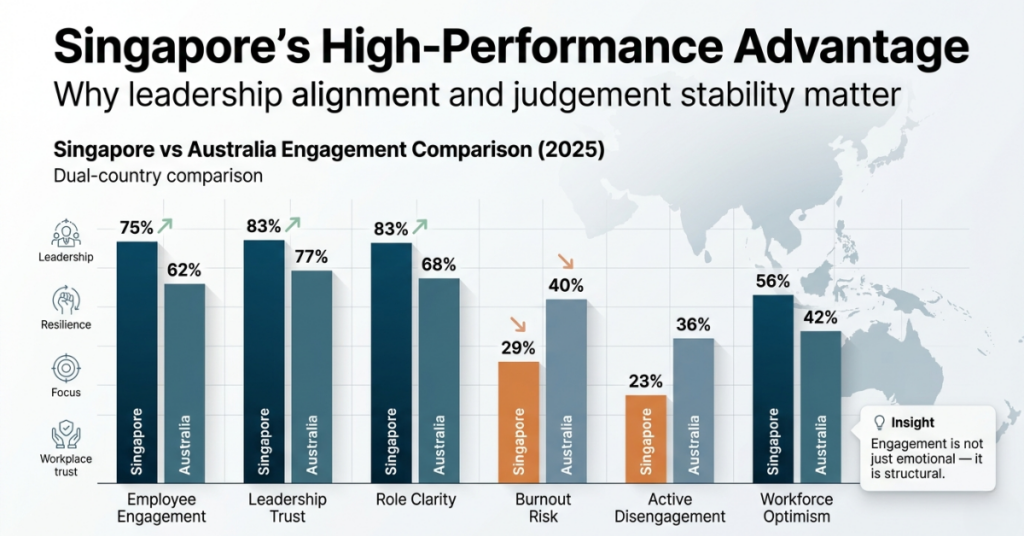
Data insights inspired by Gallup’s State of the Global Workplace 2025, This visual is an independent interpretation created by JIAU and is not affiliated with or endorsed by Gallup.
If you want this level of clarity, resilience, and workforce performance, the Judgment Index™ is your next strategic advantage.