
Most high performers don’t struggle because they lack insight.
They know their strengths.
They’ve completed assessments.
They’ve read the books, attended the workshops, and reflected on the feedback.
And yet—under pressure—they still make the same decisions, have the same conversations, and feel the same friction points resurface.
This isn’t a motivation problem.
It’s an implementation problem.
There’s a gap between knowing and doing, and most development tools stop just short of helping people cross it.
The Common Starting Point
Meet Sarah.
Sarah is a senior professional in a leadership role, experienced, capable, and highly regarded by the people she works with. She’s someone others rely on: to deliver, to support, and to steady the team when things get complex.
On paper, she was doing everything “right.”
But internally, Sarah felt the strain.
High-stakes decisions took more energy than they should.
Difficult conversations lingered longer than necessary.
And despite her competence, she sometimes second-guessed herself more than she expected.
She didn’t lack self-awareness.
She lacked clarity about how she was making decisions and why certain situations drained her more than others.
What the Personal Narrative Report Revealed
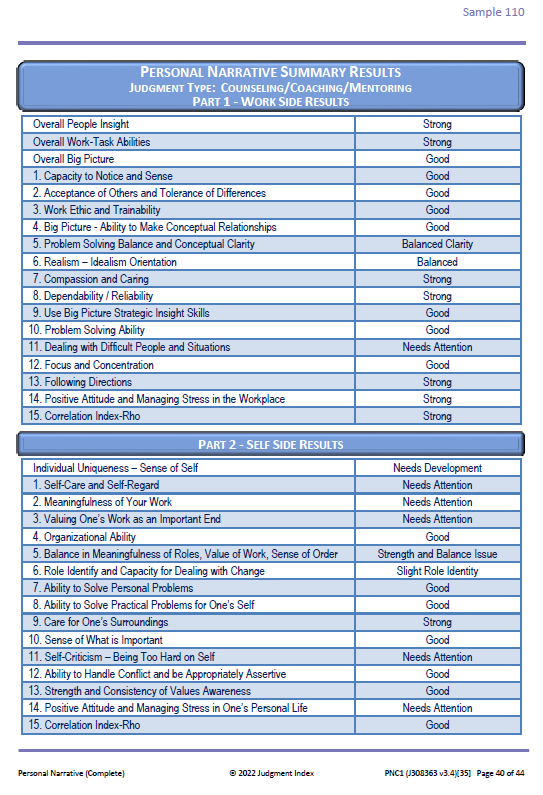
Sarah’s Personal Narrative Report gave her something previous tools hadn’t: a clear picture of how her judgement actually operated.
The report showed that her strongest judgement capacities were:
- Work–Task judgement (reliability, execution, follow-through)
- People and relationship insight (empathy, care, coaching orientation)
Her Big Picture judgement was solid, but not dominant meaning she often defaulted to doing and supporting before stepping back to integrate broader implications.
This reframed her experience immediately.
What Sarah had interpreted as self-doubt or inconsistency wasn’t a flaw.
It was a values-based judgement pattern playing out under pressure.
Why This Kind of Report Helps—Not Just for Sarah
This is where Personal Narrative Reports are different from traditional assessments.
Rather than categorising personality or measuring preference, they:
- Reveal how values influence judgement
- Show where decision-making stays strong and where it weakens under stress
- Connect work behaviour with personal sustainability
- Highlight practical leverage points, not abstract traits
For Sarah, that meant understanding:
- Why she handled tasks and people so effectively
- Why conflict and overload drained her disproportionately
- Why pushing harder wasn’t the solution but adjusting strategy was
For others, the insight looks different but the benefit is the same:
Clarity about how judgement actually works in real situations.
What a Values-Based Assessment Really Reveals
At its core, a values-based assessment doesn’t ask:
“What kind of person are you?”
It asks:
“How do you evaluate situations, make decisions, and choose action especially when things get complex?”
This matters because judgement:
- Is situational, not static
- Shifts under stress, fatigue, and pressure
- Directly affects leadership, safety, wellbeing, and performance
Understanding judgement allows individuals, leaders, and organisations to move beyond surface behaviour and address the real drivers behind decisions.
One Assessment, Many Ways to Use It
One of the most practical strengths of the Judgment Index approach is its efficiency.
A single validated assessment can generate a library of tailored reports—over 70 options—each designed for a different purpose.
From one assessment, organisations can access insights for:
- Individual development and coaching
- Leadership capability and decision-making
- Team dynamics and collaboration
- Wellbeing, stress, and sustainability
- Safety, risk awareness, and reliability
- Recruitment, selection, and role alignment
In other words:
One assessment. Many reports. Multiple perspectives. Real application.
Individuals complete one measure, yet managers, coaches, and teams can each work with reports relevant to their context without re-testing or duplicating effort.
(You can explore this approach further at www.jiau.com.au.)
Turning Insight into Action
With clarity came practical change for Sarah.
She didn’t try to “fix herself.”
She worked with her judgement.
She began to:
- Pause earlier in complex decisions to integrate people, task, and big-picture factors
- Address difficult conversations sooner instead of carrying emotional load internally
- Set clearer boundaries around workload and expectations
- Reduce self-criticism by recognising where her judgment was already strong
Her report also highlighted that sustained performance required attention to self-care, meaning, and unrealistic self-expectations, not more effort.
Small changes.
Lasting impact.
The Bigger Pattern
Sarah’s experience isn’t unique.
Across leaders, teams, and organisations, the same pattern appears:
- Insight without strategy leads to frustration
- Strengths become blind spots under pressure
- Performance declines when judgement is unsupported
Development works best when people understand how they make decisions, where stress affects them most, and how to apply strategies that strengthen judgement over time.
Where Development Really Begins
Growth doesn’t start with another label or personality type.
It starts with understanding judgement and knowing how to support it.
That’s where insight turns into impact.
What if stronger judgement wasn’t left to chance?
Sarah’s experience highlights something many organisations overlook:
judgement is not just an individual capability, it’s a collective one.
When organisations invest in understanding how their people make decisions, they don’t just support individual development. They strengthen leadership, reduce friction, improve safety, and build teams that make better decisions under pressure.
A single, values-based assessment can provide insights for individuals, managers, and teams, supporting development, wellbeing, leadership, to manage psychosocial hazards and improving performance across the organisation.
If you’re responsible for developing people, leading teams, or shaping culture, this is where meaningful development begins.
→ Explore how organisations are using judgement-based insights to strengthen decision-making.
If you want to see how the report looks for your specific sector, we can provide industry-matched samples on request.