

There’s a pattern that often emerges among people in leadership roles.
The strongest leaders are often the most exhausted.
They are the people everyone relies on.
- The ones who say “yes” when their schedules are already full.
- The ones who carry the emotional weight of their teams.
- The ones who stay steady and composed for everyone else, even when they feel like they’re shaking on the inside.
From the outside, these leaders look resilient, capable, and composed.
And often, they are.
But beneath that strength, there can be a quiet cost.
The Hidden Burden of Being the Strong One
Leadership naturally demands resilience, courage, decisiveness, and the ability to inspire others.
These qualities are widely recognised as essential to effective leadership.
However, those same qualities can also create pressure.
When leaders feel responsible for everyone else’s stability, they can begin to suppress their own uncertainty, fatigue, or stress. Strength becomes a role they feel they must perform constantly.
Resilience turns into endurance without recovery.
Commitment slowly turns into self-erasure.
And exhaustion becomes the silent companion of leadership.
When Strength Becomes a Mask
Many leaders tell themselves that feeling overwhelmed means they’re not strong enough.
But that belief is rarely true.
Exhaustion isn’t a failure. It’s a signal.
A signal that the demands placed on you may be exceeding the space you’ve created to process them.
A signal that the responsibility you carry might need reflection, support, or recalibration.Leadership research consistently shows that even strong leaders can experience obstacles that affect performance, particularly when stress management, self-criticism, or difficult interpersonal dynamics begin to take a toll.
In other words, leadership capability and leadership strain often exist at the same time.
Understanding the Patterns Behind Leadership Decisions
One of the most powerful ways to support leaders is helping them understand how they make decisions, what drives their reactions, and how they respond under pressure.
This is where the Judgment Index™ can be valuable.
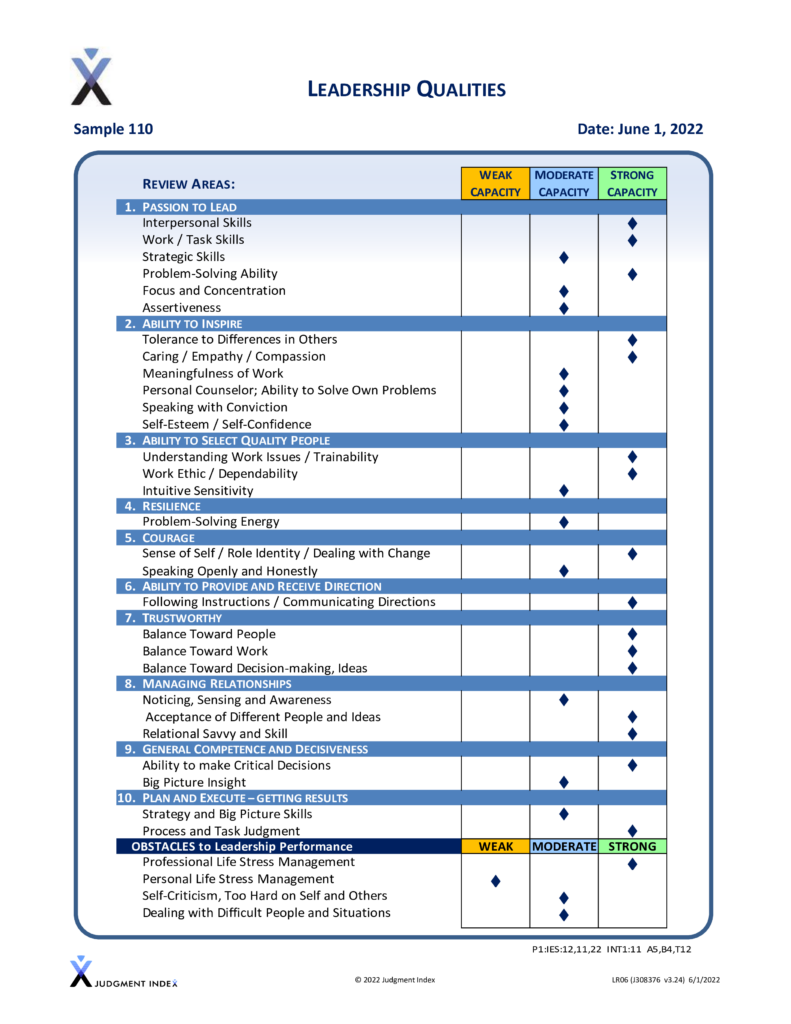
For example, the Leadership Qualities Report helps leaders better understand the strengths and patterns that shape their leadership behaviour. The report examines key areas such as passion to lead, the ability to inspire others, resilience, courage, relationship management, and decision-making capability.
It also highlights potential leadership obstacles, such as stress management, self-criticism, and handling difficult interpersonal situations that can quietly affect even the most capable leaders.
This leadership qualities report is just one of more than 70 individual and group reports within the Judgment Index™ platform, designed to help organisations better understand leadership strengths, team dynamics, and potential barriers to performance.
How does the Judgment Index™ work?
It’s a simple online assessment that takes around 20 minutes to complete.
Participants rank two sets of 18 statements from best to worst, based on their own personal values.
There are no right or wrong answers.
The goal is not to measure intelligence or personality, but to understand the judgement patterns and values that guide decision-making.
The assessment is part of a broader values-based platform that includes more than 70 individual and group reports, helping organisations better understand leadership strengths, team dynamics, and potential obstacles to performance.
The Turning Point for Leaders
Something meaningful happens when leaders finally have space to explore what is driving their decisions, reactions, and pressure responses.
Not a dramatic transformation.
Not a loud or visible shift.
But something deeper.
They begin to understand how they think, how they carry responsibility, and how they respond under pressure.
They stop merely surviving leadership.
And they begin inhabiting it.
Leadership becomes less about holding everything together and more about leading with clarity, awareness, and sustainable strength.
Leadership Should Give Something Back
Leadership will always require effort, responsibility, and resilience.
But it should not require the disappearance of the leader.
When leaders understand their judgement patterns, pressure triggers, and decision dynamics, they can lead with both strength and sustainability.
They can carry responsibility without carrying it alone.
And they can rediscover something many leaders quietly lose along the way:
The ability to experience leadership not just as a burden, but as meaningful work.
A Conversation Worth Having
If you’re reading this and thinking, “That’s me,” you’re not the only one carrying that truth.
Many capable leaders carry more than anyone around them realises.
Sometimes the most powerful step is simply having a space to talk about what leadership is costing you and what it could give back.
If that conversation would be helpful, feel free to reach out at www.jiau.com.au
Because leadership shouldn’t just demand strength.
It should also support the person who carries it.
If you want to see how the report looks for your specific sector, we can provide industry-matched samples on request.