
Hiring Is Changing Faster Than We Think
If you feel like hiring has become more unpredictable lately, you’re not imagining it.
Between AI-assisted interview answers, shifting work expectations, and candidates who present extremely well but perform inconsistently, the landscape is changing faster than most managers can keep up with.
As we move into 2026, one thing is clear:
The interview is no longer the most reliable way to understand candidates.
What you see in the interview isn’t always what you get in the workplace.
Based on current behaviour patterns and hiring trends, here are the three types of candidates you’re most likely to meet in 2026 and how the Judgment Index (JI) helps reveal who is really sitting in front of you.
1. The Polished Interviewer (AI-Assisted and Highly Prepared)
This candidate presents flawlessly.
Every answer is smooth.
Every example sounds impressive.
Every behavioural story is structured perfectly.
And in 2026, many of these “perfect” responses will be quietly refined or even generated by AI tools.
This means you are often seeing an idealised version of the candidate, not their true behavioural capacity.
Why this becomes a hiring risk
The polished interviewer often:
- Sounds stronger than they actually are
- Overstates soft skills
- Interviews extremely well
- Struggles once real pressure or ambiguity is introduced
This can lead to the classic manager reaction:
“But they were so good in the interview… what happened?”
What the JI reveals
The Judgment Index cuts through the performance and shows:
- How they actually make decisions
- Whether they can handle pressure
- Their true reliability and follow-through
- Whether their interview “examples” match real-world capability
The polished interviewer may sound like a star.
But the JI shows whether they can perform like one.
2. The High-Potential Candidate (Strong Ability, Needs Support)
This candidate doesn’t always “sell” themselves the way polished interviewers do.
They may come across as slightly nervous, reserved or humble.
Yet underneath, they often have significant strengths that make them outstanding performers, especially when paired with the right support.
Typical traits
- High values and strong work ethic
- Learns quickly
- Wants feedback and growth
- May struggle expressing achievements
- Doesn’t always “win” the interview, but excels once hired
Managers often overlook them because they don’t perform dramatically in interviews.
What the JI reveals
The JI brings forward:
- Their genuine strengths
- Areas that need development
- Potential for leadership or long-term growth
- What type of support will help them thrive
High-potential candidates are incredibly valuable but only if a manager can see them beyond the interview.
3. The Quiet High-Performer (Strong Judgement, Understated Presence)
This candidate is calm, modest and steady.
They don’t exaggerate, perform or over-sell.
They’re honest, practical and grounded.
Yet in interviews, they’re often overshadowed by more polished speakers.
And that’s a missed opportunity, because quiet high-performers are usually the most reliable, consistent, and low-maintenance team members a manager could hope for.
Why they’re often missed
- They don’t use dramatic stories
- Their answers are simple and honest
- They don’t embellish achievements
- They underplay strengths
- They appear “less exciting” than others
In truth, they are often the strongest behavioural fit in the entire applicant pool.
What the JI reveals
The JI highlights the strengths their interview style often hides, revealing that they may not promote themselves confidently, but their capability is genuine and dependable. And because we offer reports tailored to your industry needs, managers don’t have to interpret results blindly.
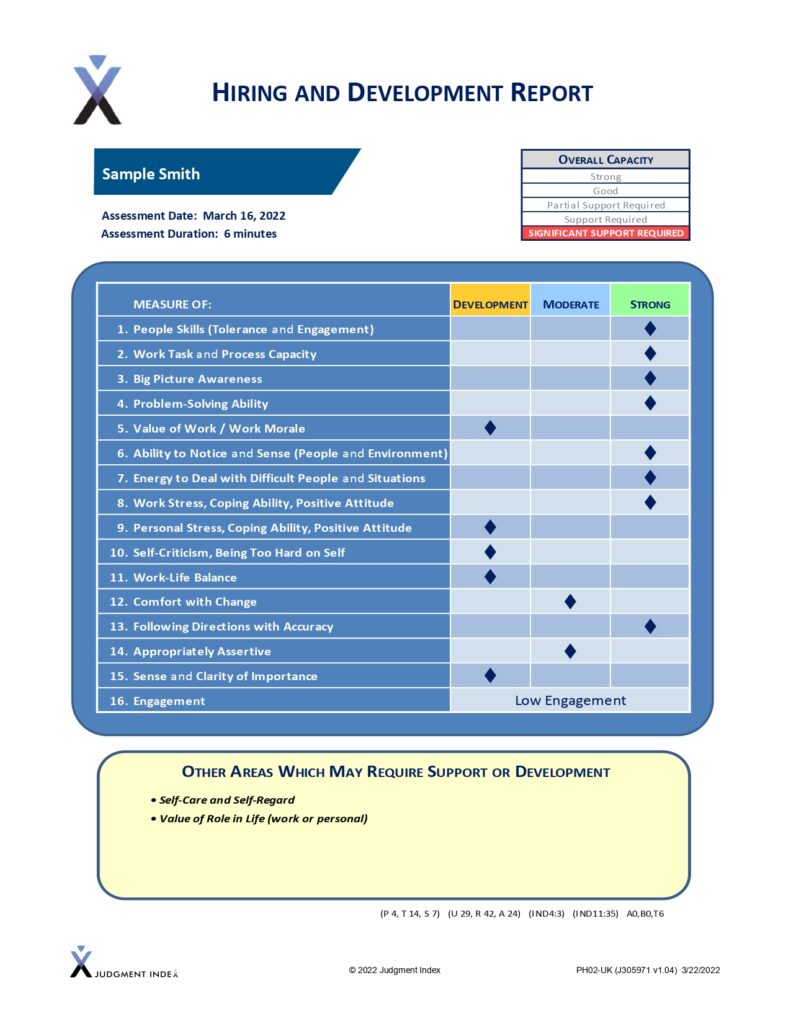
For example, our Hiring and Development Report clearly breaks down critical measures such as People Skills, Work Task and Process Capacity, Problem-Solving Ability, Comfort with Change, and more, making it easy to see where a candidate is strong and where they may need support.
This level of insight gives managers confidence in identifying quiet high-performers who may not shine in an interview but demonstrate strong judgement, reliability and long-term potential in the workplace.
Quiet high-performers don’t try to impress you, they impress you by what they do once they’re in the role.
Why the Judgment Index Matters More Than Ever in 2026
As interviews become less reliable and AI tools continue to shape how candidates present themselves, managers need a way to see what is real, not curated.
The JI provides:
- Behavioural clarity
- Predictability under pressure
- True strengths and risk markers
- Practical onboarding guidance
- A deeper understanding of work style and capacity
Instead of guessing, managers gain data-driven insight into who a candidate truly is.
Who Are You Really Interviewing?
In 2026, you’ll meet:
- Polished performers
- High-potential candidates
- Quiet high-performers
But the real question is:
How do you know which one is sitting in front of you?
Interviews won’t tell you.
Resumes won’t tell you.
References may not tell you.
The Judgment Index will.
If you want to see how the report looks for your specific sector, we can provide industry-matched samples on request.