
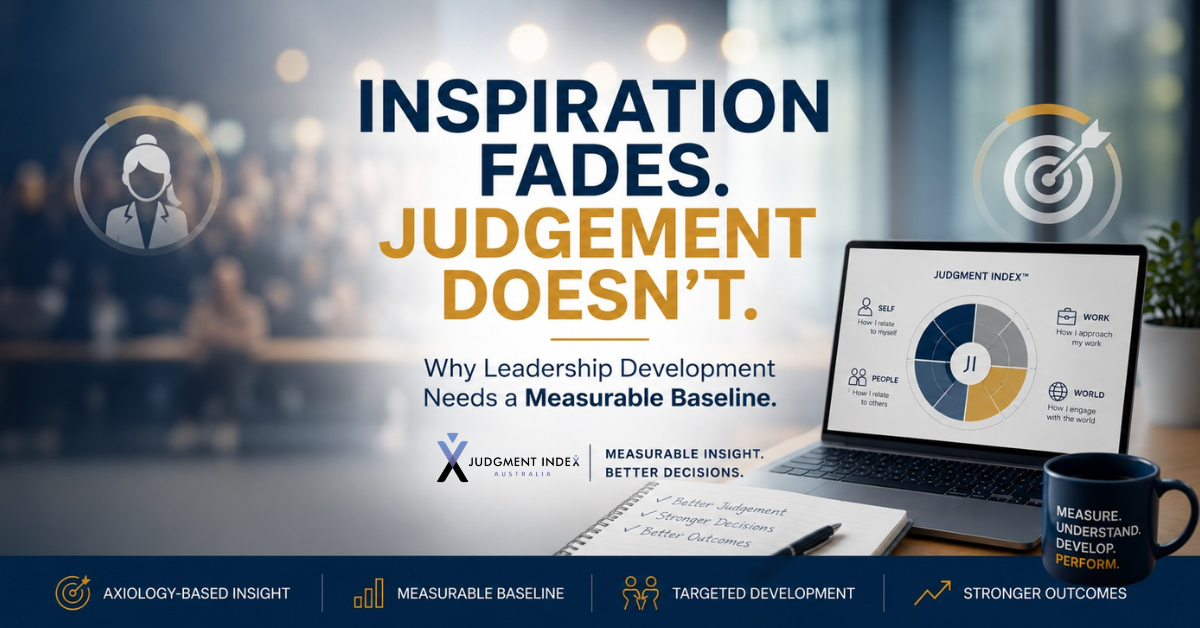
There is an important shift happening in leadership development.
For years, conferences, workshops and professional development programs have been designed to inspire.
And inspiration matters.
A powerful speaker can challenge assumptions. A workshop can introduce a different way of thinking. A leadership program can give someone the confidence to approach a difficult situation differently.
But what happens after everyone returns to work?
A week later, meetings resume. Deadlines return. Pressure builds. The notebook from the workshop closes and leaders are once again making hundreds of decisions that affect their people and their organisation.
The question is no longer simply:
Did our leaders find the experience valuable?
It is:
Did it actually change the way they make decisions?
That requires something inspiration alone cannot provide.
It requires a measurable baseline.
From Inspired Leaders to Better Decisions
Organisations already measure many of the outcomes associated with leadership.
They track employee engagement, retention, productivity, safety incidents, absenteeism and financial performance.
But these measures often tell us what happened after decisions have already been made.
What if we could better understand what is influencing those decisions in the first place?
Behind every leadership decision is a value system.
It influences what a person notices, what they prioritise, how they interpret situations and how they respond when pressure increases.
Understanding those underlying patterns gives organisations another way to approach leadership development.
Instead of asking only whether someone attended training, we can begin asking:
What is driving the decisions this person makes, and where are the opportunities for development?
Measuring What Sits Beneath Behaviour
Many traditional assessments focus on personality, preferences or behavioural style.
The Judgment Index™ takes a different approach.
It is an axiology and values-based assessment tool designed to provide insight into the value structures that influence judgement and decision-making.
Rather than simply describing how someone may appear or behave, the assessment helps reveal how an individual values themselves, their work and the world around them.
This can provide organisations with insight into areas such as:
- how someone approaches decisions under pressure
- where potential judgement risks may exist
- how an individual relates to people, tasks and systems
- where targeted development may have the greatest impact
- areas of strength that can be built upon
The purpose isn’t to put people into a personality category.
It is to create a clearer baseline for development.
Because if you don’t understand the starting point, it becomes difficult to determine whether development is actually moving the needle.
The Cake Theory: Looking at the Whole Person
One way JIAU explains this is through our Cake Theory.
Think about performance as a cake.
What we see on the surface, including skills, behaviours and outcomes, is only part of the picture.
Underneath are the ingredients influencing those outcomes.
A person’s relationship with themselves.
How they approach their work.
How they understand and respond to other people.
Their awareness, balance and capacity to make effective judgements when circumstances become difficult.
Leadership development often concentrates on the visible layer.
Teach the skill.
Introduce the framework.
Provide the strategy.
Those things matter, but lasting development also requires understanding the person who is applying them.
That is where values-based measurement can add another dimension.
Momentum Needs a Starting Point
Imagine investing significantly in leadership development without establishing a baseline beforehand.
Six months later, how do you know what changed?
Attendance tells you who participated.
Feedback forms tell you whether people enjoyed the experience.
Engagement surveys may provide useful organisational indicators.
But none necessarily tells you whether an individual leader is now exercising better judgement.
A measurable baseline allows organisations to move from:
“We delivered leadership development.”
to:
“We understand where development is needed and can target our investment accordingly.”
That distinction matters.
Especially when leadership decisions influence recruitment, retention, succession, culture, safety and organisational performance.
Turning Insight Into Development
Measurement should not replace human development.
It should make development more useful.
When leaders understand their own patterns of judgement, development conversations can become more specific.
Instead of generic advice, they can explore the areas most relevant to how they personally think, value and decide.
HR and People leaders can also make more informed decisions about where coaching, mentoring or development resources may have the greatest impact.
The result is a shift from development based primarily on participation to development informed by evidence.
Inspiration Is the Beginning
There will always be a place for experiences that inspire leaders.
We need new ideas.
We need conversations that challenge established thinking.
We need opportunities for leaders to step away from the everyday and reconsider how they lead.
But inspiration should be the beginning of development, not the measurement of its success.
The bigger opportunity is to take that momentum back into the organisation and turn it into meaningful, measurable development.
Because the question isn’t simply whether your leaders leave a room feeling inspired.
It’s whether they return to work better equipped to make the decisions that matter.
What Would You Discover?
If you’d like to see what measuring judgement looks like in practice, request a Judgment Index™ Sample Report.
Explore the type of insight organisations can use across leadership development, recruitment and succession planning.
Get a Sample Report:
https://www.jiau.com.au/get-a-sample-report/
➡️ Follow Us on LinkedIn!
☎️ Book a Discovery Call!
📜 Request a Sample Report!
Interested in learning more about how the Judgment Index can benefit your organisation? Request a sample report below!