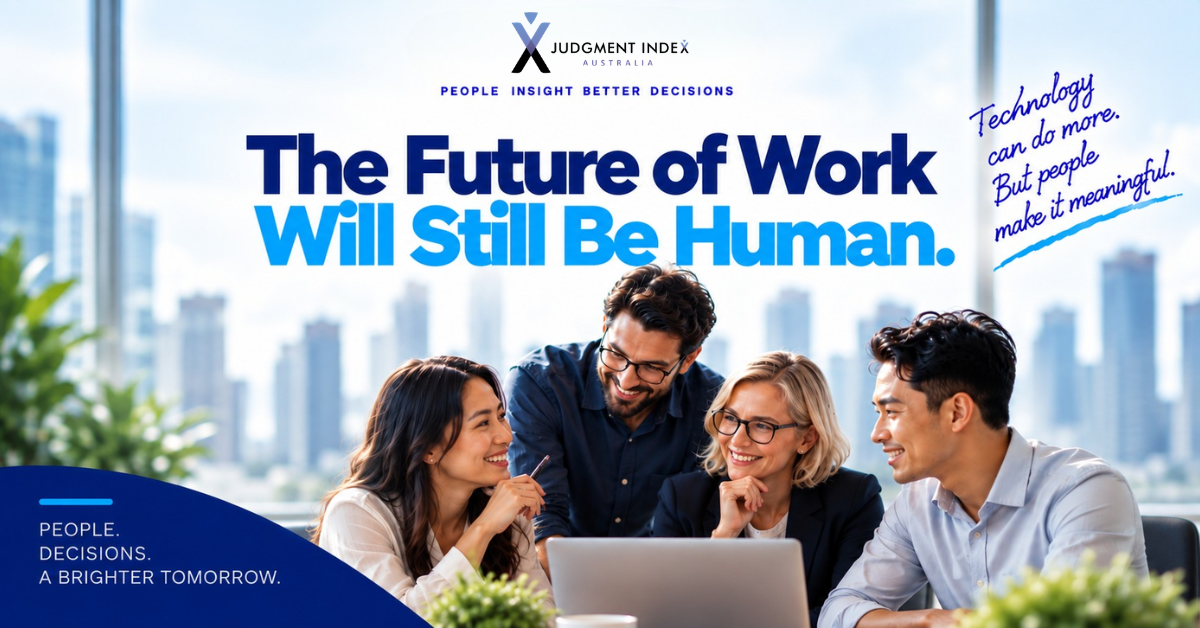
The future of work is often discussed through the lens of technology. Artificial intelligence, automation, hybrid work and digital transformation dominate the conversation. Yet behind every new system, process and platform are people who still need to make decisions, adapt to change, build trust and perform under pressure.
That is why human sustainability deserves a more prominent place in the future-of-work conversation.
High performance is valuable. Sustainable high performance is more valuable still.
What Do We Mean by Human Sustainability?
Human sustainability is the capacity for people to continue contributing effectively through change, complexity and pressure without progressively undermining the human foundations that make performance possible.
It is not about removing challenge from work. It is not about lowering standards. And it is not simply another term for employee wellbeing.
It asks whether performance can continue.
Can people maintain clarity when priorities compete? Can leaders make sound decisions when information is incomplete? Can teams preserve trust during difficult periods? Can high performers recover from pressure rather than simply accumulate it?
These are strategic questions because the consequences of unsustainable performance eventually appear somewhere: turnover, burnout, poor decisions, strained relationships, reduced adaptability or leadership instability.
Why the Future of Work Makes This More Important
Today’s organisations are navigating conditions that barely existed in their current form a decade ago: widespread hybrid work, rapidly advancing AI, constant information flow, skills shortages, faster decision cycles and persistent uncertainty.
Technology can make work more efficient, but it can also increase its pace. More information does not always create more clarity. Faster access to options does not automatically produce better decisions.
This creates a paradox. As technology becomes more capable, the quality of human judgement becomes more important.
AI can process information. Humans still determine priorities, ethics, relationships, trust, culture and accountability. Those responsibilities do not disappear when technology improves. They become the areas where human contribution matters most.
The Hidden Problem With Measuring Performance Alone
Most organisations are very good at measuring outcomes. Revenue. Productivity. Delivery. Retention. Safety. Engagement. Customer results.
Those measures tell leaders what happened. They do not always reveal what is happening underneath the result.
A high performer may continue hitting targets while carrying unsustainable pressure. A leader may appear calm while their capacity to recover is diminishing. A team may deliver successfully while trust is quietly deteriorating.
By the time these issues appear in lagging indicators, the organisation may already be dealing with the consequences.
Human sustainability encourages leaders to look not only at output, but at the human capacity supporting that output.
Judgement Under Pressure
The quality of judgement is often easiest to see when conditions are difficult.
When priorities are clear and time is abundant, many people can make sound decisions. Pressure changes the equation. Information becomes incomplete. Multiple priorities compete. Emotions influence the room. The cost of a poor decision increases.
Future-ready organisations therefore need to understand more than whether people have the technical capability to perform a role. They also need insight into how people think, judge and respond when complexity increases.
The Judgment Index™ is designed to help make these human factors more visible. It measures how individuals operate across personal and professional environments, helping organisations better understand leadership, decision-making, wellbeing and performance.
Trust Is Part of Sustainable Performance
Sustainable performance is not an individual issue alone. It is relational.
Teams need to communicate when circumstances change. Leaders need people to challenge assumptions. Colleagues need to trust that concerns can be raised. Organisations need people who can disagree without damaging the relationships required to keep working together.
That is why trust and relational judgement matter in the future of work. An organisation can have exceptional technology and highly skilled people, yet still struggle if its teams cannot maintain trust through uncertainty.
Five Questions Leaders Should Ask
- Can our people maintain clarity when priorities compete?
- Can our leaders make sound decisions without perfect information?
- Can teams maintain trust during periods of change?
- Can high performers sustain their contribution without quietly exhausting their capacity?
- Do our current people measures tell us enough about how individuals will respond under pressure?
If these questions are difficult to answer, the organisation may have a gap between what it measures and what modern work actually demands.
Building Future-Ready Organisations
The future of work will continue to bring new technology, new roles and new ways of operating. Organisations will need to keep developing technical skills, digital literacy and AI capability.
But those investments should sit alongside an equally important question: what human capabilities do we need to understand and strengthen?
Resilience. Adaptability. Trust. Ethical decision-making. Leadership. Judgement under pressure. These capabilities shape whether people can use technology well and whether performance can be sustained when conditions change.
The goal is not to choose between technology and people. It is to build organisations where both become stronger together.
Human sustainability is therefore not simply a wellbeing initiative. It is part of organisational capability, leadership effectiveness and long-term performance.
Explore the Future of Human Work
The future of work is not simply about adopting new technology. It is about understanding the people who will use it. Explore JIAU’s Future of Human Work to learn more about Human-Centric Judgement Intelligence™ and the capabilities shaping modern organisational performance.
—————————————————————————————–
What Would You Discover?
If you’d like to see what measuring judgement looks like in practice, request a Judgment Index™ Sample Report.
Explore the type of insight organisations can use across leadership development, recruitment and succession planning.
Get a Sample Report:
https://www.jiau.com.au/get-a-sample-report/
➡️ Follow Us on LinkedIn!
☎️ Book a Discovery Call!
📜 Request a Sample Report!
Interested in learning more about how the Judgment Index can benefit your organisation? Request a sample report below!