
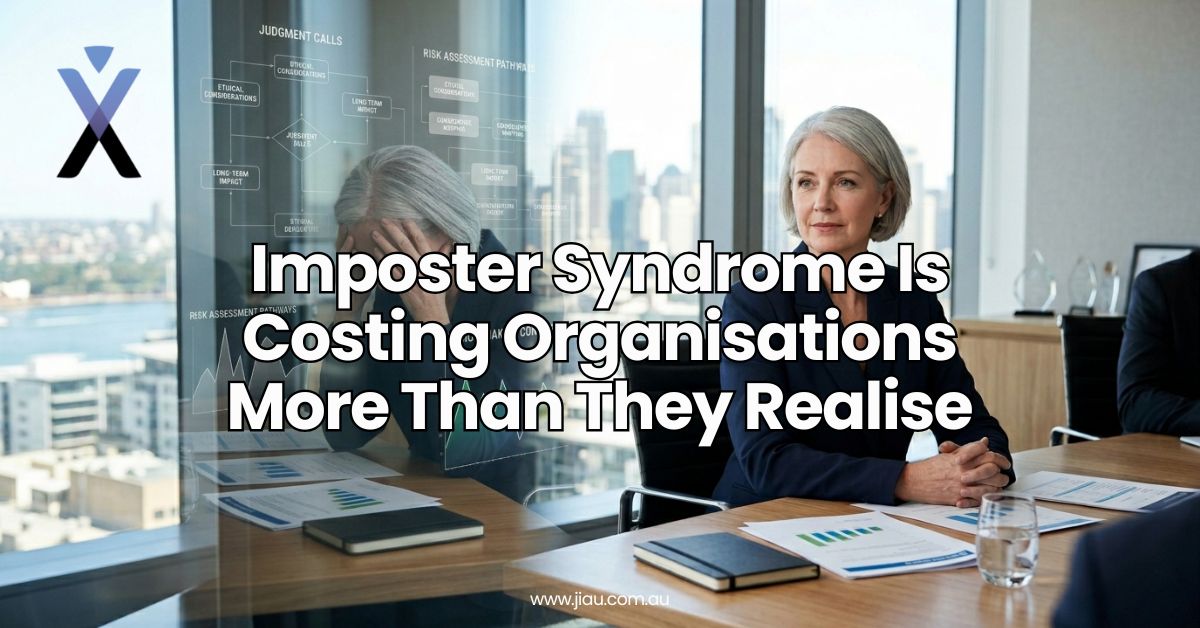
Most people assume imposter syndrome only affects junior employees or people early in their careers.
The reality is very different.
Research published in the Journal of General Internal Medicine found that imposter syndrome affects professionals at every level, with prevalence rates reaching as high as 82% in some studies.
The issue is especially common among experienced leaders. The KPMG Women’s Leadership Study reported that 75% of executive women have experienced imposter syndrome during their careers:
In Australian workplaces, this often goes unnoticed because high performers are skilled at masking it.
They continue delivering results. They stay busy. They overprepare. They push harder.
But underneath the surface, the internal pressure builds.
Why Imposter Syndrome Becomes a Leadership Problem
Imposter syndrome is not simply about confidence.
It affects judgement.
When leaders constantly question themselves internally, it influences how they make decisions, communicate with teams, manage pressure, and respond to challenges.
You may see leaders who:
- hesitate before making decisions
- Over analyse simple situations
- struggle to delegate
- avoid visibility or recognition
- become perfectionistic
- overwork to prove their value
- seek constant reassurance
Over time, this creates strain not only for the individual, but for the organisation.
Teams can experience:
- slower decision-making
- reduced innovation
- communication breakdowns
- increased burnout
- lower psychological safety
In many organisations, these patterns are treated as personality issues rather than measurable leadership risks.
That is where The Judgment Index™ (JI) changes the conversation.
What Is The Judgment Index™?
The Judgment Index™ is a values-based assessment tool designed to measure how individuals process judgement, pressure, emotional load, and decision-making.
Unlike personality assessments that focus only on behavioural styles, the JI examines the internal judgement systems driving behaviour under pressure.
The JI helps organisations understand:
- leadership behaviour
- emotional regulation
- resilience capacity
- decision-making under pressure
- internal strain
- workplace judgment patterns
How the JI Report Works
The JI assessment identifies patterns across multiple areas of judgment and values alignment.
The report highlights:
- where leadership judgement is balanced
- where pressure may distort decision-making
- areas of overcompensation
- emotional strain indicators
- resilience strengths and risks
- communication tendencies
For example, a senior executive may appear highly capable externally but internally show:
- low self-regard
- elevated emotional strain
- reduced recovery capacity
- over-reliance on achievement for validation
This insight allows leadership development and coaching to become targeted and practical rather than generic.
Why Australian Organisations Are Paying Attention to Judgment Risk
More organisations are recognising that leadership capability is not only about skills and experience.
It is also about how leaders respond under pressure.
JIAU explores this further in its article on why human judgment is becoming a board-level risk metric.
Australian workplaces are navigating:
- hybrid work
- economic uncertainty
- leadership fatigue
- talent retention challenges
- increasing mental health pressures
The JI helps organisations:
- identify leadership blind spots
- improve communication
- strengthen resilience
- support succession planning
- reduce burnout risk
- improve team trust and psychological safety
Most importantly, it helps leaders understand themselves with clarity rather than criticism.
Individual Growth Starts With Self-Awareness
People cannot change what they cannot see.
The JI gives individuals language and insight into patterns they may have carried for years without understanding.
Instead of asking:
“Why do I feel this way?”
Leaders begin asking:
“What is driving this pattern, and how can I improve it?”
That shift creates healthier leadership, stronger teams, and more sustainable performance.
➡️ Follow Us on LinkedIn!
☎️ Book a Discovery Call!
📜 Request a Sample Report!
Interested in learning more about how the Judgment Index can benefit your organisation? Request a sample report below!