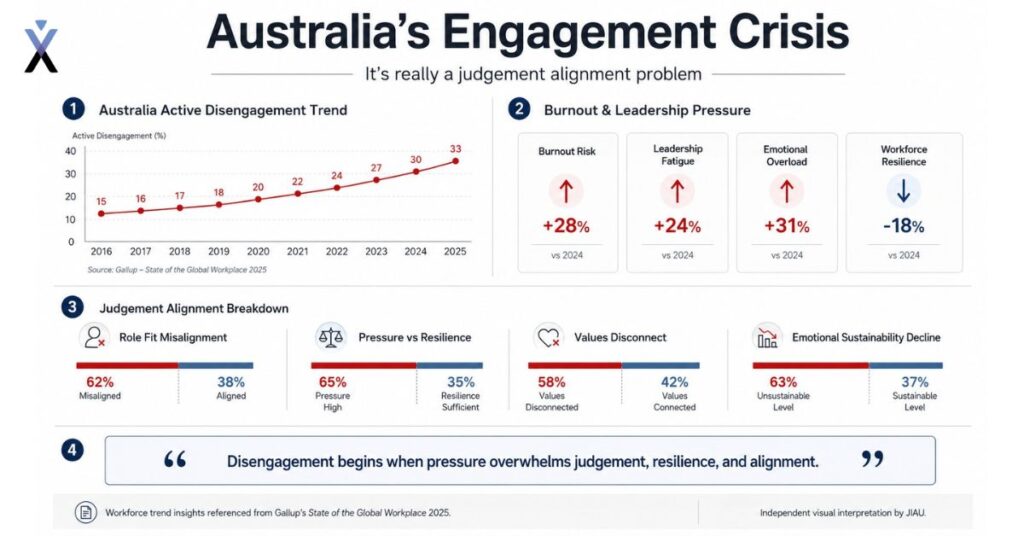
According to Gallup workplace reporting and APAC workforce analysis, Australia is experiencing one of the region’s most concerning workforce trends:
Rising active disengagement.
Burnout is accelerating.
Leadership fatigue is growing.
And increasingly, employees feel emotionally disconnected from the organisations they work for.
Most companies still describe this as an engagement problem.
But that diagnosis is incomplete.
Australia’s real challenge is judgement alignment.
Because disengagement rarely begins with motivation alone.
It begins when pressure, values, leadership, role fit, and emotional sustainability fall out of alignment over time.
And unless organisations start understanding the deeper psychological systems underneath workforce performance, disengagement will continue accelerating.
Australia’s Workforce Is Highly Capable — But Increasingly Exhausted
Australia still possesses one of APAC’s most highly skilled workforces.
Employees demonstrate strong:
- technical capability
- strategic thinking
- problem-solving ability
- adaptability
- operational competence
But capability alone no longer guarantees resilience.
Many employees now operate inside environments characterised by:
- chronic urgency
- emotional overload
- leadership inconsistency
- constant change
- low recovery
- unclear expectations
Over time, these conditions weaken workforce stability significantly.
Active Disengagement Is More Dangerous Than Quiet Quitting
Unlike silent disengagement, active disengagement becomes culturally contagious.
Employees who feel emotionally disconnected often begin:
- withdrawing psychologically
- losing trust in leadership
- communicating cynically
- resisting organisational direction
- emotionally detaching from outcomes
This affects:
- morale
- collaboration
- innovation
- retention
- resilience
- leadership effectiveness
And once active disengagement spreads through teams, rebuilding culture becomes significantly harder.
Burnout Is No Longer an Individual Problem
Many organisations still treat burnout as:
- a wellbeing issue
- a resilience issue
- an employee coping issue
But burnout is increasingly systemic.
It emerges when workplace systems continuously overload judgement capacity.
Employees today are expected to:
- multitask constantly
- absorb uncertainty
- adapt rapidly
- manage emotional pressure
- maintain high performance without recovery
Eventually, judgement quality weakens.
And when judgement weakens:
- emotional regulation declines
- resilience collapses
- decision-making deteriorates
- engagement falls
- trust weakens
This is why burnout cannot be solved through surface-level wellness initiatives alone.
Judgement Alignment Is the Missing Workforce Metric
Most organisations measure:
- productivity
- engagement
- retention
- satisfaction
- performance outcomes
But they rarely measure how aligned employees actually are psychologically.
Judgement alignment determines:
- how people respond under pressure
- whether resilience remains sustainable
- how effectively leaders regulate teams
- how employees interpret meaning
- how emotional stability is maintained
Without alignment, performance becomes fragile.
Even highly capable teams eventually destabilise under prolonged pressure.
Why Leadership Fatigue Is Accelerating
According to Gallup workplace trend reporting and broader APAC workforce analysis, leadership stress and emotional fatigue are becoming increasingly visible across modern workplaces.
Australian leaders now operate inside some of the most psychologically demanding environments in decades.
Many experience:
- decision fatigue
- emotional overload
- constant urgency
- reactive management pressure
- psychological exhaustion
This creates leadership instability.
And unstable leaders unintentionally create unstable teams.
Under chronic pressure:
- communication deteriorates
- empathy weakens
- strategic clarity declines
- emotional regulation becomes harder
- workplace trust erodes
This is now becoming one of Australia’s biggest organisational risks.
Why Traditional Engagement Surveys Are Failing
Most engagement tools measure symptoms after workforce deterioration already exists.
They assess:
- morale
- satisfaction
- emotional sentiment
- workplace happiness
But they rarely measure:
- pressure resilience
- judgement quality
- emotional sustainability
- burnout vulnerability
- leadership stability
- role fit alignment
This leaves organisations reacting too late.
By the time engagement visibly declines:
- resilience may already be severely weakened
- leadership fatigue may already be widespread
- disengagement may already be culturally embedded
How the Judgment Index™ Changes the Conversation
The Judgment Index™ focuses on the deeper human performance systems underneath engagement.
It measures:
- where disengagement begins
- where pressure collapses judgement
- where values and role fit are misaligned
- where burnout risk is forming
- where leadership resilience is weakening
- where emotional sustainability is deteriorating
This allows organisations to identify workforce instability far earlier than traditional engagement tools.
That changes leadership strategy completely.
Instead of reacting after burnout spreads, organisations can strengthen resilience proactively.
Australia Needs Leadership Intelligence — Not More Initiatives
Many organisations continue launching:
- engagement campaigns
- culture initiatives
- wellness programs
- motivational strategies
Yet workforce instability continues growing.
Why?
Because most initiatives focus on symptoms rather than underlying human performance systems.
Australia does not need more superficial engagement programs.
It needs deeper leadership intelligence.
The organisations that outperform over the next decade will understand:
- judgement under pressure
- resilience sustainability
- psychological alignment
- leadership stability
- emotional recovery
- human adaptability
The Future Workplace Will Reward Human Sustainability
The next generation of workforce advantage will belong to organisations that optimise:
- resilience
- trust
- emotional sustainability
- judgement quality
- leadership capability
- alignment under pressure
Because the future of work is becoming increasingly psychological.
Technical capability alone is no longer enough.
Employees now need workplaces that support sustainable human performance over time.
Final Thought
According to Gallup workplace reporting and APAC workforce analysis, rising disengagement across Australia reflects deeper challenges around burnout, leadership pressure, and workforce alignment.
Australia’s engagement problem is not fundamentally about engagement.
It is about judgement alignment.
Employees disengage when:
- pressure overwhelms resilience
- meaning disappears
- leadership becomes unstable
- emotional sustainability collapses
- values disconnect from work
The organisations that recognise this earliest will build the most resilient, adaptable, and high-performing workforces in the future economy.
Because sustainable performance is no longer just operational.
It is deeply human.
Gallup Workplace Insights https://news.gallup.com/topic/workplace.aspx
Gallup Global Employee Engagement Data https://www.gallup.com/394373/indicator-employee-engagement.aspx
Australia & NZ Workplace Engagement Analysis https://www.puzzlepartners.com.au/post/australia-nz-vs-the-world-the-latest-engagement-leadership-metrics
If you want to reduce active disengagement, strengthen leadership judgement, and build resilient high-performance teams, the Judgment Index™ is your next strategic step.
➡️ Follow Us on LinkedIn!
☎️ Book a Discovery Call!
📜 Request a Sample Report!
Interested in learning more about how the Judgment Index can benefit your organisation? Request a sample report below!