
According to Gallup’s APAC workplace reporting, Thailand has achieved something many developed economies are struggling to replicate:
A dramatic rise in employee engagement.
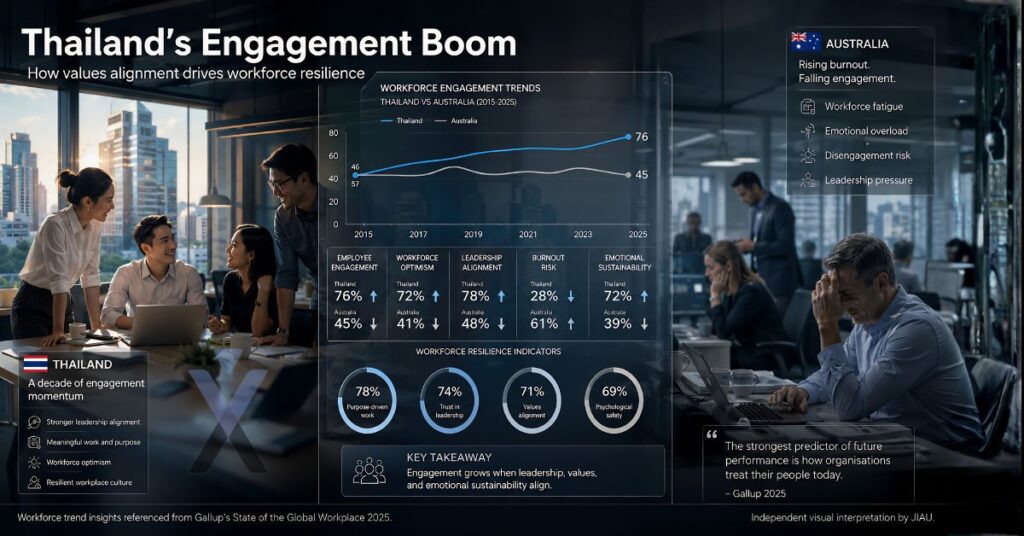
Over the past decade, Thailand’s engagement reportedly doubled from 14% to 34%, making it one of APAC’s strongest workplace improvement stories.
Australia, meanwhile, remains largely stagnant.
Burnout is rising. Active disengagement continues increasing. Emotional fatigue is becoming deeply embedded across many industries.
So what explains Thailand’s momentum?
The answer goes far beyond economics.
Thailand’s workforce transformation reflects the growing importance of:
- values alignment
- meaningful work
- leadership capability
- emotional connection
- resilient judgement systems
And for Australian organisations searching for sustainable workforce performance, the lessons are significant.
Engagement Growth Requires More Than Perks
Many organisations still treat engagement as something that can be improved through:
- benefits
- incentives
- wellness initiatives
- flexible work policies
But sustainable engagement growth usually reflects deeper psychological and organisational alignment.
Thailand’s rise increasingly demonstrates the importance of:
- leadership trust
- shared purpose
- stronger manager capability
- cultural cohesion
- relational stability
- emotional sustainability
These are not “soft” factors.
They directly affect workforce resilience and long-term performance.
Australia’s Workforce Is Losing Emotional Connection
Australian organisations remain highly capable operationally.
But emotionally, many employees feel increasingly disconnected from:
- leadership
- purpose
- contribution
- organisational values
- long-term meaning
This creates dangerous workforce instability.
Employees may still perform technically while psychologically disengaging underneath.
That distinction matters enormously.
Because emotional disconnection eventually weakens:
- resilience
- innovation
- collaboration
- leadership trust
- retention
- performance consistency
Thailand Demonstrates the Power of Purpose-Driven Work
One of Thailand’s strongest workforce shifts has been the movement toward more purpose-driven engagement.
Employees increasingly perform better when they believe:
- their work matters
- leadership is authentic
- values are shared
- contribution is meaningful
- teams operate relationally
Purpose strengthens resilience under pressure.
Without purpose, pressure becomes emotionally exhausting much faster.
This is one of the core differences emerging across APAC today.
Why Judgement Determines Engagement Sustainability
Engagement is not simply emotional enthusiasm.
It is heavily shaped by judgement quality under pressure.
Employees with stronger judgement systems are better able to:
- regulate stress
- maintain resilience
- prioritise effectively
- communicate clearly
- sustain motivation
- adapt strategically
Employees without that alignment experience:
- emotional fatigue
- reactive behaviour
- disengagement
- cognitive overload
- burnout
This is why organisations increasingly need deeper human performance intelligence.
The Leadership Shift Behind Thailand’s Rise
Manager capability plays an enormous role in engagement sustainability.
Thailand’s engagement improvements increasingly reflect stronger leadership behaviours around:
- communication
- support
- relational trust
- emotional awareness
- accountability
- alignment
Employees rarely disengage because of workload alone.
More often, disengagement develops when pressure is poorly managed and leadership trust weakens.
Strong leaders stabilise workforce judgement under stress.
Weak leaders amplify instability.
Why Traditional Engagement Surveys Are Becoming Obsolete
Most engagement tools focus on visible emotional outcomes.
They ask employees:
- whether they feel engaged
- whether they are satisfied
- whether morale feels positive
But they rarely measure:
- resilience quality
- burnout vulnerability
- coping capacity
- pressure tolerance
- values alignment
- judgement stability
This creates delayed organisational awareness.
By the time engagement scores visibly decline:
- resilience may already be collapsing
- leadership fatigue may already be spreading
- emotional trust may already be damaged
The Judgment Index™ identifies these risks earlier.
How the Judgment Index™ Measures Workforce Alignment
The Judgment Index™ measures the psychological drivers underneath workforce performance.
It evaluates:
- values alignment
- judgement quality
- pressure resilience
- burnout risk
- role fit accuracy
- leadership stability
- emotional sustainability
This allows organisations to identify where engagement is strengthening — or quietly deteriorating — before major performance decline occurs.
That creates a major strategic advantage.
Australia Must Rethink Performance Sustainability
Australia’s workforce challenge is no longer simply operational.
It is psychological.
Many employees now operate inside environments characterised by:
- chronic urgency
- emotional exhaustion
- leadership inconsistency
- high stress
- low recovery
- declining optimism
Over time, these conditions weaken workforce resilience dramatically.
Thailand demonstrates what becomes possible when organisations strengthen:
- alignment
- purpose
- leadership quality
- emotional sustainability
- judgement under pressure
The Future Workplace Will Reward Human Resilience
The future of workforce performance will increasingly belong to organisations that understand:
- resilience
- emotional sustainability
- leadership trust
- judgement quality
- meaningful contribution
- psychological alignment
Productivity alone is no longer enough.
Modern organisations must now optimise human performance systems, not just operational systems.
That shift is already reshaping workforce success across APAC.
Final Thought
Thailand’s engagement rise offers Australia an important lesson:
People sustain performance longer when they feel aligned, valued, and emotionally connected to their work.
Engagement grows when:
- judgement remains strong under pressure
- leadership stabilises teams
- values align with contribution
- resilience becomes sustainable
The organisations that understand this fastest will build the strongest workforce advantage over the next decade.
Gallup Workplace Insights https://news.gallup.com/topic/workplace.aspx
Gallup Global Employee Engagement Data https://www.gallup.com/394373/indicator-employee-engagement.aspx
Southeast Asia Workplace Engagement Overview https://www.theculturecontract.com/post/employee-engagement-in-southeast-asia-the-2025-opportunity-gap
Gallup State of the Global Workplace Report https://www.gallup.com/workplace/349484/state-of-the-global-workplace.aspx
If Australia wants Thailand-level engagement gains, stronger leadership resilience, and more sustainable workforce performance, the Judgment Index™ is the most precise place to start. Contact us at or request a sample report below.
➡️ Follow Us on LinkedIn!
☎️ Book a Discovery Call!
📜 Request a Sample Report!
Interested in learning more about how the Judgment Index can benefit your organisation? Request a sample report below!